Door type
Indoor high-speed door
An indoor high-speed door is a fast acting door that separates zones inside a building quickly and tightly without slowing down forklift and tugger train traffic. It typically opens at around 1.5 to 2.5 m/s and is designed for high cycle rates.
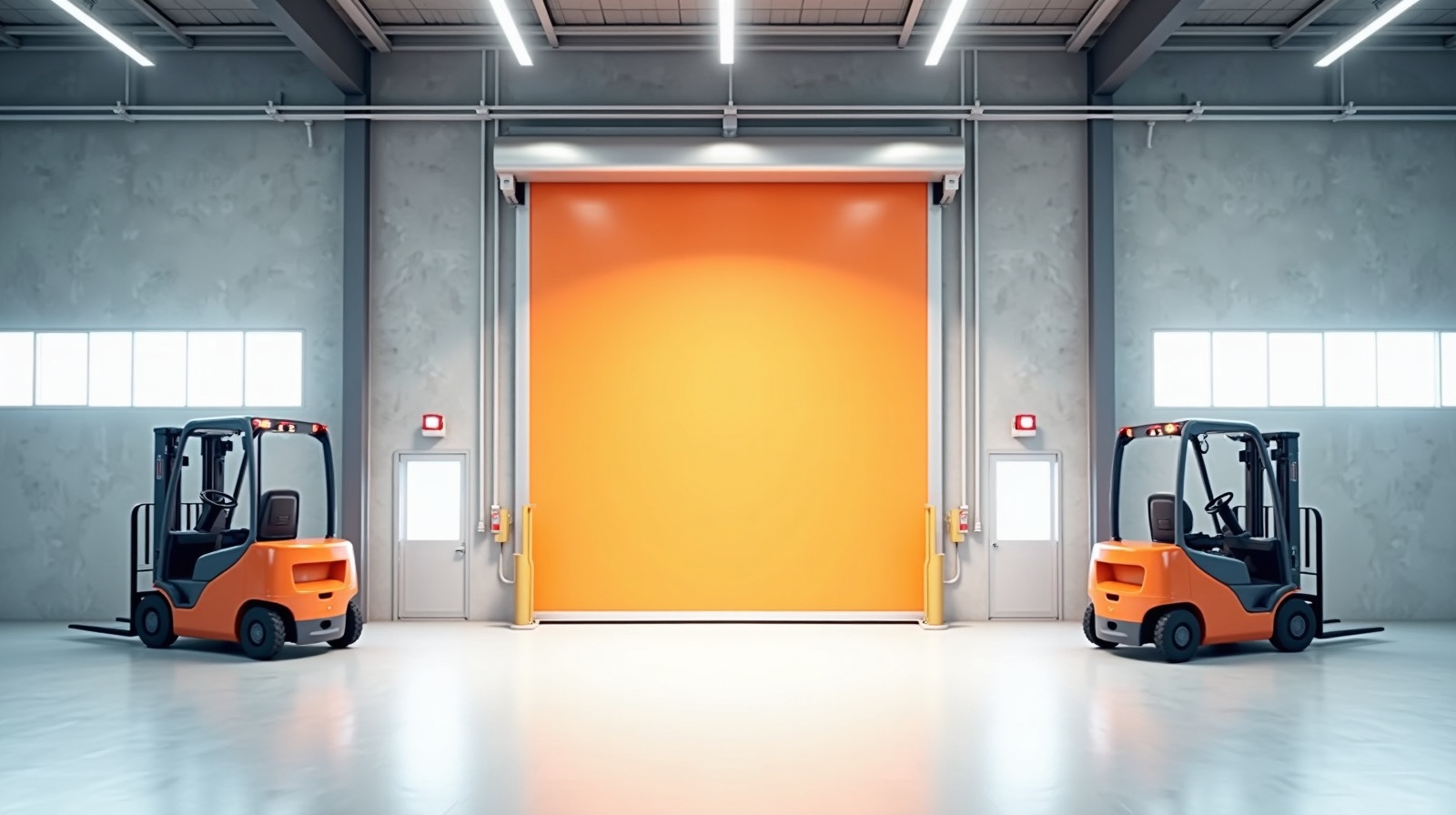
An indoor high-speed door – often simply called an internal door – is not part of the building envelope but sits between two areas inside a hall or between parts of a building. It does not have to withstand wind or weather, so it can be lighter, faster and designed for more opening cycles per day than an outdoor door. Its jobs are climate separation, dust and noise control and keeping internal traffic flowing in an orderly way.
Flexible indoor doors are used wherever forklifts, tugger trains or staff pass through an opening every few minutes: between goods-in and the warehouse, between sections of production, at the boundary of temperature-controlled areas or at openings for conveyor systems. Every second the door closes sooner reduces draughts, heat loss and waiting time – and with several hundred passages a day, that adds up noticeably.
Zone and climate separation means more than temperature. An indoor door keeps dust from fabrication away from assembly, dampens noise, screens off paint shops or wash areas and keeps draughts away from workstations. Because the curtain closes the opening completely, it separates far more effectively than overlapping strips. How high-speed doors work in general and which designs exist is explained in our high-speed doors overview.
Indoor doors come in several versions: with a single-skin PVC curtain as standard, with transparent vision panels for two-way traffic, insulated for areas with a temperature difference, or as a particularly light clear curtain door for extreme cycle rates. Which version fits depends on traffic, climate and safety requirements.
Key features
- Opening speed typically around 1.5 to 2.5 m/s, depending on size
- Designed for high cycle rates in multi-shift operation
- Light, flexible PVC curtain, optionally with vision panels or insulated
- Self-repairing zip system against impact damage available
- Climate, dust and noise separation between hall zones
- Activation by radar, induction loop, radio remote or plant control system
- No wind load requirement, hence a lightweight construction
How it works
An opening cycle on an indoor door takes just a few seconds. When a forklift approaches, a radar motion detector picks up the movement; alternatively, an induction loop in the floor detects the vehicle or the driver triggers the door by radio. The drive accelerates the lightweight curtain, winds it onto the shaft above the opening and brakes before the end position. Once the vehicle has passed, the light curtain reports the opening clear and the door closes after a short, adjustable hold-open time.
Speed is controlled by a frequency inverter: fast opening so that nobody has to brake, controlled closing so that the safety edge and light curtain react reliably. A well-adjusted control system also avoids unnecessary cycles, for example with radar fields that ignore cross traffic or with a partial opening for pedestrians.
If an impact does occur, a curtain with a zip system pops out of the side guide in a controlled way instead of tearing. On the next cycle it re-threads itself automatically. In halls with dense forklift traffic, this is the difference between a brief interruption and a standstill waiting for a service technician.
Design and components
An indoor door consists of the curtain, two side guides, the winding shaft in the headroom, the drive with control unit and the safety and activation devices. Because no wind load has to be absorbed, the wind bars and reinforcements of an outdoor door are not needed. The curtain stays light and the moving mass small – the basis for high speed and many load cycles with little wear.
The curtain is usually made of tear-resistant PVC-coated fabric: single-skin for pure separation tasks, double-skin or insulated where temperature differences have to be bridged. Transparent strips or vision panels make oncoming traffic visible in good time. The frame is galvanised, powder-coated in a RAL colour or, in wet and hygiene areas, made of AISI 304 stainless steel.
The control unit has inputs for radar, induction loop, radio and pull switch as well as volt-free contacts for linking to traffic lights, airlock logic or the control system of conveyor lines. This lets you integrate the indoor door into existing processes, for example so that it opens in sync with a conveyor or an automated guided vehicle.

Technical data
| Feature | Typical value |
|---|---|
| Opening speed | typically around 1.5 to 2.5 m/s, lightweight versions up to around 3 m/s |
| Closing speed | slower than opening, typically around 0.5 to 1 m/s |
| Cycle rate | designed for several hundred cycles per day, more with the right specification |
| Size range | typically around 2,000 × 2,500 mm to 4,000 × 4,500 mm, up to around 5,000 × 5,000 mm possible |
| Wind resistance class EN 12424 | class 0 (no requirement), higher if there are pressure differences between zones |
| Curtain | single-skin PVC fabric, optionally with vision panels or insulated |
| Insulation | single-skin U-value above around 5 W/m²K, insulated curtains considerably better |
| Headroom | around 400 to 650 mm, depending on the system |
| Side room | around 150 to 250 mm per side, more on the drive side depending on motor position |
Guide values – exact figures depend on size, curtain and design.
Advantages
- Short opening times reduce heat and cooling losses between hall zones
- Higher throughput because forklifts and tugger trains do not wait for the door
- Fewer draughts at workstations near the door
- Separation of dusty, noisy and temperature-controlled areas
- Minimal downtime thanks to a self-repairing curtain
- Greater safety in mixed traffic with vision panels and traffic lights
- Lightweight construction that is easy to retrofit in existing buildings
Limitations
- Not suitable for the building envelope, as there is no wind load reserve
- A single-skin curtain provides hardly any insulation when closed
- No burglar resistance and not a fire-rated closure
- Often oversized if the opening is used only rarely
- Needs space above and beside the opening for the shaft and side guides
Configure your indoor high-speed door to measure
Configure nowTypical applications
- Internal forklift and tugger train traffic
- Transitions between production, warehouse and dispatch
- Separation of temperature, dust or noise zones
- Openings for conveyor systems and automated guided vehicles
- Screening off paint shops, wash areas or cleaning zones
- Access to chilled areas above 0 °C with an insulated curtain
What to consider when choosing
Three variables are decisive: the cycle rate, i.e. how often the door opens per hour, the required speed and whether climate separation is needed. For very high cycle rates, a particularly lightweight curtain and a drive with frequency inverter pay off. If there is a significant temperature difference between the zones, an insulated curtain is worth considering.
Traffic matters just as much: which vehicles pass through the door, with what mast height and load, and do pedestrians use it too? This determines the clear width and height, the right activation devices and the safety equipment. For mixed traffic, a light curtain, vision panels and traffic lights make sense; for dense forklift traffic, a curtain with crash protection.
In the configurator for indoor high-speed doors, you select the location, dimensions, curtain, drive and accessories. If you are unsure about individual points, simply leave them open – we will clarify the right specification with you when we respond to your enquiry.
Planning and installation
Headroom and side room come first: above the opening, the door needs around 400 to 650 mm for the shaft and drive, depending on the system, and around 150 to 250 mm on each side for the guides. If crane rails, pipework, sprinklers or cable trays clash with the headroom, compact designs or a different drive position will help. The door is usually mounted in front of the wall, alternatively within the reveal. Common sizes and space requirements are summarised on our sizes page.
The floor in the door area should be level so that the bottom edge seals tightly; minor unevenness can be compensated by a floor profile. Provide a power supply close to the door for the drive and, for induction loops, a saw cut in the hall floor. Indoor doors are well suited to existing buildings because they do not require any work on the building envelope. The door is delivered direct from the factory and installed by your installer or your in-house maintenance team – see delivery and installation.
If pedestrians cannot use the door safely, the workplace regulations in the country of installation generally require a clearly marked pedestrian door in the immediate vicinity. This question belongs in the planning just as early as the traffic routes in front of and behind the door, floor markings and the position of the activation devices.
Typical sizes
2,000 × 2,500 mm to 4,000 × 4,500 mm. Enter your exact size in the configurator, together with curtain, colour, drive and accessories. Common sizes are listed under High-speed door sizes.
Safety and standards
Indoor high-speed doors are power-operated doors within the scope of the product standard EN 13241; safety in use is covered by EN 12453. Standard equipment includes a safety edge on the bottom edge and a light curtain that monitors the passage area without contact and stops the door before it touches anyone. In mixed traffic, vision panels, traffic lights and clear floor markings increase safety further.
For power failures, an emergency opening by hand crank, chain hoist or backup battery should be provided, especially if the door is located on an escape route. As regards fire protection: a high-speed door with a PVC curtain is not a fire-rated closure. If the opening lies in a fire wall or between fire compartments, an additional fire door or fire shutter approved for this purpose is required, and the indoor door is arranged and controlled so that it does not obstruct its closing. The requirements are set by the building's fire safety strategy.
Maintenance and service life
Power-operated doors must be inspected by a competent person according to the manufacturer's instructions and the national workplace regulations in the country of installation, typically at least once a year. Indoor doors with high cycle rates should be serviced more often – at several hundred cycles a day, roughly every three to six months. The checks cover the curtain, guides, shaft, drive, end positions, speed and all safety devices. This work is carried out by your installer or a local maintenance provider.
Wear parts are mainly the curtain, seals and the components of the zip system. Because the indoor door is protected from the weather, it wears more slowly than an outdoor door. Service life depends on the number of load cycles and impacts, not on calendar age.
Cost and price factors
The cost of an indoor high-speed door depends on size, curtain, drive, activation devices, safety equipment and installation conditions. A single-skin standard indoor door is the leanest version; an insulated curtain, stainless steel frame, vision panels, backup battery or a link to conveyor technology increase the scope. Freight and installation by your installer are additional cost items on your side.
The investment pays off through energy, throughput and avoided downtime: less heating or cooling loss between zones, no waiting times for forklifts and fewer repairs thanks to crash protection. How the price factors add up is explained on our page on high-speed door cost; a non-binding quotation for your opening is available via the configurator.
Compared with other door types
Compared with a PVC strip curtain, an indoor high-speed door provides a genuine, tight separation instead of overlapping strips, plus safety technology and automation. Compared with a conventional roller shutter, it opens many times faster – around 1.5 to 2.5 m/s instead of usually less than 0.5 m/s – and copes with high cycle rates, but offers no burglar resistance.
If the door is part of the building envelope, an outdoor high-speed door with wind load reserve is the right choice. If it closes off a freezer area, you need a heated freezer door. Among indoor doors, the PVC high-speed door is the standard, the clear curtain door the version for maximum cycle rates and the spiral door the quiet, durable solution with an aluminium slat panel.
| Criterion | Indoor high-speed door | PVC strip curtain | Roller shutter |
|---|---|---|---|
| Opening speed | around 1.5 to 2.5 m/s | no drive, vehicles push through | usually below 0.5 m/s |
| Sealing | high, full-surface closure | low, gaps remain | high |
| Cycle rate | very high | unlimited, strips wear | low |
| Visibility | good with vision panels | limited, strips get scratched | none |
| Personal protection | light curtain, safety edge, traffic lights | no active protection | safety edge |
| Behaviour on impact | curtain re-threads with zip system | strips give way | slats dent, repair needed |
| Burglar resistance | low | none | high |
Other door types
Frequently asked questions
What is an indoor high-speed door?
An indoor high-speed door separates two areas inside a building, such as production and warehouse. As a fast acting door, it typically opens at around 1.5 to 2.5 m/s, closes immediately after the vehicle has passed and so keeps draughts, heat, dust and noise in check.
How fast does an indoor high-speed door open?
Depending on drive and size, indoor doors open at around 1.5 to 2.5 m/s, lightweight versions even faster. A conventional roller shutter usually stays below 0.5 m/s. Closing is deliberately slower so that the safety devices can react reliably.
What is the difference between an indoor and an outdoor high-speed door?
An outdoor door sits in the building envelope and must withstand wind and weather; it needs a suitable wind resistance class according to EN 12424. An indoor door is generally exempt from this and can therefore be lighter, faster and designed for higher cycle rates.
Is an indoor door suitable for climate separation?
Yes. Thanks to short opening times and a tight curtain, an indoor door noticeably reduces the exchange of air and heat between areas of a hall. Where temperature differences are greater, an insulated curtain also reduces losses while the door is closed.
What happens if a forklift hits the door?
With a self-repairing system, the curtain pops out of the guide in a controlled way instead of tearing and re-threads itself automatically the next time the door opens. A service call is then usually unnecessary, and traffic resumes after a short interruption.
Can an indoor high-speed door serve as a fire door?
No. A high-speed door with a PVC curtain is not a fire-rated closure. In fire walls or between fire compartments, an additional fire door or fire shutter approved for this purpose is required, and the indoor door is planned so that it does not obstruct its closing. The building's fire safety strategy is decisive.
Does an indoor high-speed door need maintenance?
Yes. Inspection and maintenance follow the manufacturer's instructions and the national workplace regulations in the country of installation and are carried out by a competent person, typically your installer or a maintenance provider. At high cycle rates, a shorter service interval is advisable. More on our delivery and installation page.
Can an indoor door be integrated with conveyor systems?
Yes. Radar, induction loops, traffic lights and volt-free contacts allow the indoor door to be integrated into the material flow and existing control systems. It then opens in sync with the conveyed goods or the automated guided vehicle and closes again immediately afterwards.
Configure your high-speed door and request a quote
Choose size, curtain, drive and accessories in a few steps. You receive a non-binding quotation.