Door type
PVC high-speed door
A PVC high-speed door is a power-operated industrial door whose curtain is made of tear-resistant PVC-coated fabric and typically opens at 1.5 to 3 m/s. It is the most widely used design for openings with high cycle rates – indoors and outdoors.
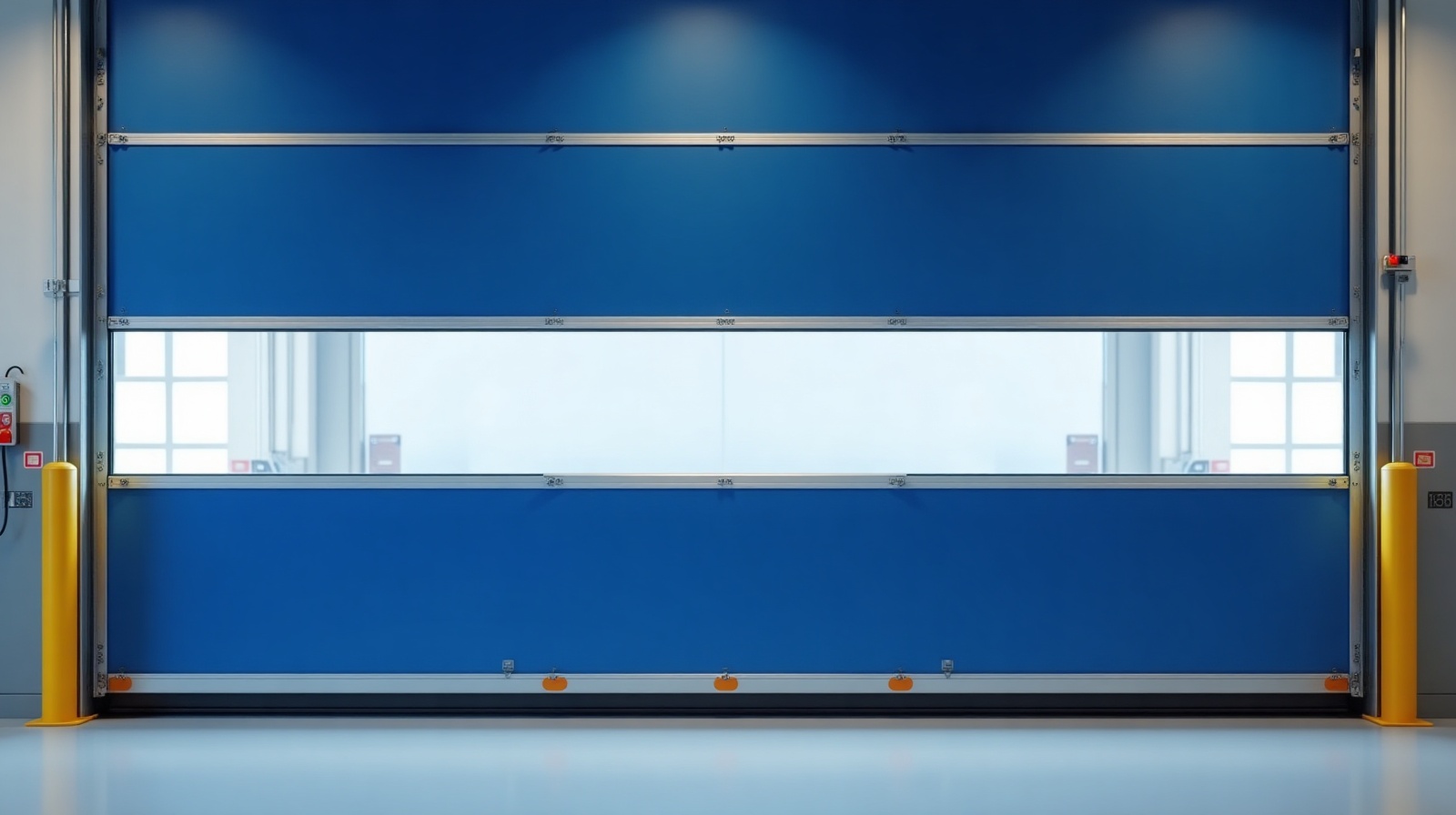
The PVC high-speed door is the most common type of high-speed door. A flexible curtain made of PVC-coated fabric winds onto a shaft above the opening and clears the passage within a few seconds. The light, tear-resistant and pliable material allows high speeds without overloading the drive and mechanics – making the PVC door the standard solution for openings with forklift, tugger train and pedestrian traffic. Depending on the market, the same design is also known as a high-speed roller door or rapid roll door.
The second reason for its popularity is how it behaves on impact. A flexible PVC curtain gives way when struck instead of denting like a rigid slatted panel. With a self-repairing zip system, it pops out of the side guide in a controlled way and re-threads itself automatically on the next run. At heavily used openings, this means less downtime and fewer repair call-outs.
The term PVC door covers several curtain versions on the same technical platform: single-skin standard curtains for maximum speed, curtains with transparent vision panels for mixed traffic, double-skin or insulated curtains for temperature-controlled areas and heated versions for freezer applications. The location decides which version fits; frame, shaft and drive remain essentially the same.
The most common equipment option is the high-speed door with vision panels. Transparent PVC strips at eye level make oncoming traffic visible before the door opens and let daylight into adjacent areas of the hall. If you need visibility across the entire door surface, the clear curtain door is the variant to look at.
Key features
- Flexible curtain made of PVC-coated polyester fabric, typically around 900 to 1,300 g/m²
- Opening speed typically around 1.5 to 3 m/s, depending on size and drive
- Self-repairing side guide (zip system) as impact protection
- Transparent vision panels with customisable number, height and width
- Curtain in RAL colours, frame galvanised, powder-coated or in AISI 304 stainless steel
- Available single-skin, double-skin, insulated or heated
- For indoor use and – with wind bars – outdoor use
How it works
A PVC high-speed door works on the winding principle: a geared motor turns the shaft in the headroom, the curtain winds up and is held at the sides in the guide rails. A frequency inverter controls start-up, top speed and braking. This lets the lightweight curtain accelerate quickly and slow down gently before the end positions, which protects fabric, shaft and drive.
A typical opening cycle runs like this: an activation device – radar motion detector, induction loop, pull switch, radio remote control or push button – reports a vehicle or person. The control unit moves the door to the upper end position, holds it open for an adjustable time and then closes it automatically. On a 3 × 3 m door, at 1.5 to 3 m/s the opening is theoretically clear after around one to two seconds, plus acceleration and braking.
Closing is usually slower than opening. The control unit limits the closing speed so that the permissible closing forces according to EN 12453 are respected. During closing, a light curtain monitors the plane of the opening; if it is interrupted, the door stops and reopens. If the bottom edge nevertheless meets an obstacle, the safety edge responds. The end positions are detected by an encoder or limit switch on the drive.
Design and components
The curtain consists of a base fabric, usually polyester yarn, coated with PVC on both sides. The fabric absorbs the tensile forces, while the coating provides tightness, UV resistance and a smooth, wipeable surface. The weight is typically around 900 to 1,300 g/m²; large doors and outdoor doors receive heavier, more tear-resistant fabric. Vision panels made of clear, flexible PVC film are welded in so that they wind up with the curtain.
The frame consists of two side guide profiles in galvanised or powder-coated steel, and in wet and hygiene areas in AISI 304 stainless steel. At the top sit the shaft, bearings and the drive, which is usually flanged on at the side, often under a shaft cover. The bottom edge carries an elastic bottom profile with safety edge. On outdoor doors, horizontal wind bars brace the curtain against wind pressure and keep it in the guide.
The control unit in a separate housing next to the door evaluates the activation and safety devices, controls the frequency inverter and offers connections for traffic lights, airlock circuits with a second door or the building management system.
| Curtain version | Property | Typical use |
|---|---|---|
| Single-skin PVC | light, very fast | indoors, high cycle rate |
| With vision panels | transparent strips | mixed traffic, safety |
| Double-skin / insulated | better insulation | temperature-controlled areas |
| Freezer PVC | heated, tight | cold stores and freezer stores |

Technical data
| Feature | Typical value |
|---|---|
| Opening speed | around 1.5 to 3 m/s, depending on size and drive |
| Closing speed | typically around 0.5 to 1.5 m/s, usually lower than when opening |
| Size range | typically around 2,000 × 2,500 mm to 5,000 × 5,000 mm |
| Curtain | PVC-coated fabric, around 900 to 1,300 g/m² |
| Wind resistance class according to EN 12424 | indoors no requirement (class 0); outdoors with wind bars typically class 2 to 3, depending on width |
| U-value | single-skin above around 5 W/m²K; double-skin or insulated considerably lower |
| Headroom | around 400 to 650 mm, depending on door height and curtain thickness |
| Side room | around 200 to 300 mm per side, drive side around 350 to 500 mm depending on motor position |
| Service life | typically designed for several hundred thousand to more than one million load cycles, depending on drive and maintenance |
Guide values – exact figures depend on size, curtain and design.
Advantages
- High opening speed thanks to low curtain weight
- Flexible curtain forgives impacts, with a zip system usually without repair
- Vision panels for safe mixed traffic and more daylight
- Wide range of versions from single-skin to freezer on the same platform
- Economical design, both to purchase and when replacing the curtain
- Smooth, wipeable surface for food and hygiene areas
Limitations
- A single-skin curtain provides hardly any insulation, U-value above around 5 W/m²K
- Low burglar resistance, no substitute for a night closure
- More sensitive to wind than slatted or sectional doors; wind bars are needed outdoors
- Vision panels become cloudy and scratched over time
- The curtain wears depending on the cycle rate and eventually needs replacing
Configure your PVC high-speed door to measure
Configure nowTypical applications
- Hall passages between production, warehouse and dispatch
- Logistics and order-picking areas with heavy forklift traffic
- Outdoor doors on sheltered to moderately wind-exposed façades
- Food and hygiene zones with stainless steel frames
- Temperature-controlled areas and cold rooms with an insulated curtain
- Crossing points with mixed traffic where vision panels are required
What to consider when choosing
Selection starts with the curtain, because it determines speed, insulation and robustness. For indoor doors with high cycle rates, a single-skin curtain is sufficient and allows the highest speeds. If there is a significant temperature difference between two areas, a double-skin or insulated curtain pays off. Below zero, there is no way around a freezer door with heated curtain; for higher insulation requirements above zero, see the insulated high-speed door.
The second criterion is traffic. With two-way traffic or crossing routes, vision panels at the eye level of forklift drivers and pedestrians are part of the basic equipment. Where collisions are frequent, a zip system is essential so that an impact does not lead to a standstill. High cycle rates call for a drive with frequency inverter; radar detectors with direction detection avoid unnecessary openings caused by cross traffic.
The third criterion is the location. Outdoors, the wind resistance class according to EN 12424 determines suitability; on highly exposed façades or with large widths, a spiral door may be the better choice. Choose the curtain colour according to visibility and corporate identity – strong colours make the door more conspicuous in traffic. Common RAL colours can be selected directly in the configurator.
Planning and installation
To plan a PVC high-speed door, you need four dimensions: clear width, clear height, headroom and side room on the left and right. Depending on door height and curtain thickness, the shaft and drive need around 400 to 650 mm above the opening; an insulated curtain winds up thicker than a single-skin one. At the sides, there must be room for the guide profiles and, on the drive side, also for the motor, unless it is positioned above the opening. How to measure correctly is shown on our sizes page.
The usual method is face fixing in front of the opening on the wall surface, mostly on the hall side. If there is no space there, installation in the reveal is possible; the guides then reduce the clear passage width. The floor should be level and load-bearing so that the bottom edge seals tightly – a flexible floor seal can compensate for larger unevenness only to a limited extent. The drive needs a fused power supply provided on site, depending on the drive 400 V three-phase or 230 V.
In existing buildings, a PVC door can generally be retrofitted easily, including indoors behind an existing sectional door that forms the building closure. Check for pipes, crane rails, ventilation ducts or lights in the headroom. Outdoors, the wind resistance class must suit the location. The door is delivered direct from the factory across Europe and installed by your installer; what is supplied and what the installer needs is described under delivery and installation.
Typical sizes
2,000 × 2,500 mm to 5,000 × 5,000 mm. Enter your exact size in the configurator, together with curtain, colour, drive and accessories. Common sizes are listed under High-speed door sizes.
Safety and standards
A PVC high-speed door is a power-operated door and must comply with the product standard EN 13241; safety in use is covered by EN 12453, including limit values for closing forces. Typical protective devices are a light curtain in the plane of the opening, which stops the door before contact, and a safety edge on the bottom edge. Traffic lights on both sides control traffic at openings with poor visibility.
If the door is on an escape or rescue route, it must be possible to open it in an emergency, for example via an emergency opening by hand crank or an emergency power supply. Whether a high-speed door may form part of an escape route at all is determined by the building's fire safety and escape route strategy; a separate pedestrian door next to the door is often the cleaner solution.
Maintenance and service life
Power-operated doors must be inspected by a competent person before first commissioning and then at regular intervals according to the manufacturer's instructions and the national workplace regulations in the country of installation, typically at least once a year; the result is documented, for example in a logbook. On the PVC door, the focus is on the curtain, vision panels, side guide and zip elements, bottom profile, safety devices and drive. At high cycle rates, shorter service intervals make sense.
Typical wear parts are the curtain and its edge areas, seals and the bottom profile. Because a worn curtain can be replaced without replacing the frame and drive, a PVC door remains economical for many years. Inspection, curtain replacement and repairs are carried out by your installer or a local maintenance provider; replacement curtains and spare parts are available on request.
Cost and price factors
The price of a PVC high-speed door depends mainly on size, curtain version, location and equipment. Single-skin indoor doors are the most economical version; insulated curtains, wind bars for outdoor doors, stainless steel frames, vision panels, frequency inverter, emergency opening and additional activation devices increase the scope. On your side, freight, installation by your installer, the electrical connection and, if necessary, the removal of an old door have to be added. The factors are explained on our page What does a high-speed door cost?
A PVC door pays off through short opening times and thus lower heat or cooling losses, less waiting time for vehicles and less damage from impacts. The higher the cycle rate and the temperature difference, the faster the investment pays for itself. You receive a specific quotation when you put your door together in the configurator for PVC high-speed doors.
Compared with other door types
The clear curtain door and the PVC high-speed door overlap considerably: the clear curtain door is a PVC door with a particularly light, often transparent curtain tuned for maximum cycle rates. The spiral door, by contrast, uses a panel of aluminium slats that runs without contact in a spiral. It is more wind-resistant, quieter and more burglar-resistant, but more expensive and heavier; after an impact, bent slats have to be replaced.
Compared with a conventional roller shutter (usually below 0.5 m/s) or a sectional door (around 0.2 m/s), the PVC door is many times faster, but insulates less and offers less protection against break-ins. Many companies therefore combine an insulated sectional door outside as a night closure with a PVC high-speed door for day-to-day operation. A PVC strip curtain is not an equivalent alternative: it only dampens, whereas the door closes the opening completely.
| Criterion | PVC high-speed door | Spiral door | Sectional door |
|---|---|---|---|
| Opening speed | around 1.5 to 3 m/s | similarly high, depending on version | around 0.2 m/s |
| Door leaf | flexible PVC fabric | rigid aluminium slats | insulated steel sections |
| Thermal insulation | single-skin low, insulated medium | medium, better with insulated slats | good to very good |
| Behaviour on impact | gives way, zip system re-threads | slats may bend | sections and tracks are damaged |
| Wind stability | good with wind bars, limited at large widths | high, even at large sizes | high |
| Burglar resistance | low | medium to high | medium to high |
| Typical use | openings with high cycle rates | exposed outdoor doors with high cycle rates | building closure with low cycle rates |
Other door types
Frequently asked questions
What is a PVC high-speed door?
A PVC high-speed door is a power-operated high-speed door with a flexible curtain of PVC-coated fabric that winds onto a shaft when it opens. It typically opens at 1.5 to 3 m/s and is the most common design for hall passages and outdoor doors with high cycle rates.
How fast does a PVC high-speed door open?
Depending on size and drive, a PVC high-speed door opens at around 1.5 to 3 m/s, so a 3 m high door is open in about one to two seconds. Closing is usually slower so that the permissible closing forces are respected.
What happens if a forklift drives into the PVC curtain?
With a self-repairing zip system, the curtain pops out of the side guide in a controlled way instead of tearing. On the next run it re-threads itself automatically, and a service call is usually unnecessary. After repeated impacts, the edge areas and the guide should nevertheless be checked.
Is a high-speed door with vision panels worth it?
At openings with two-way traffic or crossing routes, almost always: drivers and pedestrians see each other before the door opens, and daylight reaches the adjacent hall. With insulated curtains, the transparent area is kept small because transparent strips insulate less.
Is a PVC door suitable for outdoor use?
Yes, with a reinforced curtain, wind bars and a wind resistance class according to EN 12424 that suits the location; for many outdoor doors in normal locations, class 2 to 3 is a practical choice. For façades with high wind loads, very wide openings or increased burglar resistance, a spiral door is often the better choice. More on our outdoor high-speed door page.
How well does a PVC curtain insulate?
A single-skin PVC curtain hardly insulates; its U-value is above about 5 W/m²K. Double-skin and insulated curtains reduce heat transfer considerably. However, the PVC door achieves its greatest energy effect through the short opening time, not through the insulation of the curtain.
How long does a PVC curtain last?
That depends mainly on the number of load cycles, impacts, wind and UV exposure, less on age. A worn curtain can be replaced without replacing the frame and drive. Regular maintenance detects chafing and tears at an early stage.
PVC high-speed door or spiral door – which is better?
The PVC high-speed door is lighter, more economical and forgives impacts better thanks to the zip system. The spiral door with aluminium slats is more wind-resistant, quieter and more burglar-resistant, but costs more. For hall passages, the PVC door is usually the first choice; for exposed outdoor doors, it is often the spiral door.
Configure your high-speed door and request a quote
Choose size, curtain, drive and accessories in a few steps. You receive a non-binding quotation.