Application
High-speed doors for logistics and warehousing
A high-speed door for warehouses and logistics is a power-operated industrial door at internal transfer points, storage zones and access routes that lets forklifts, tugger trains and AGVs pass without waiting. It opens at around 1.5 to 3 m/s and closes immediately after each passage.
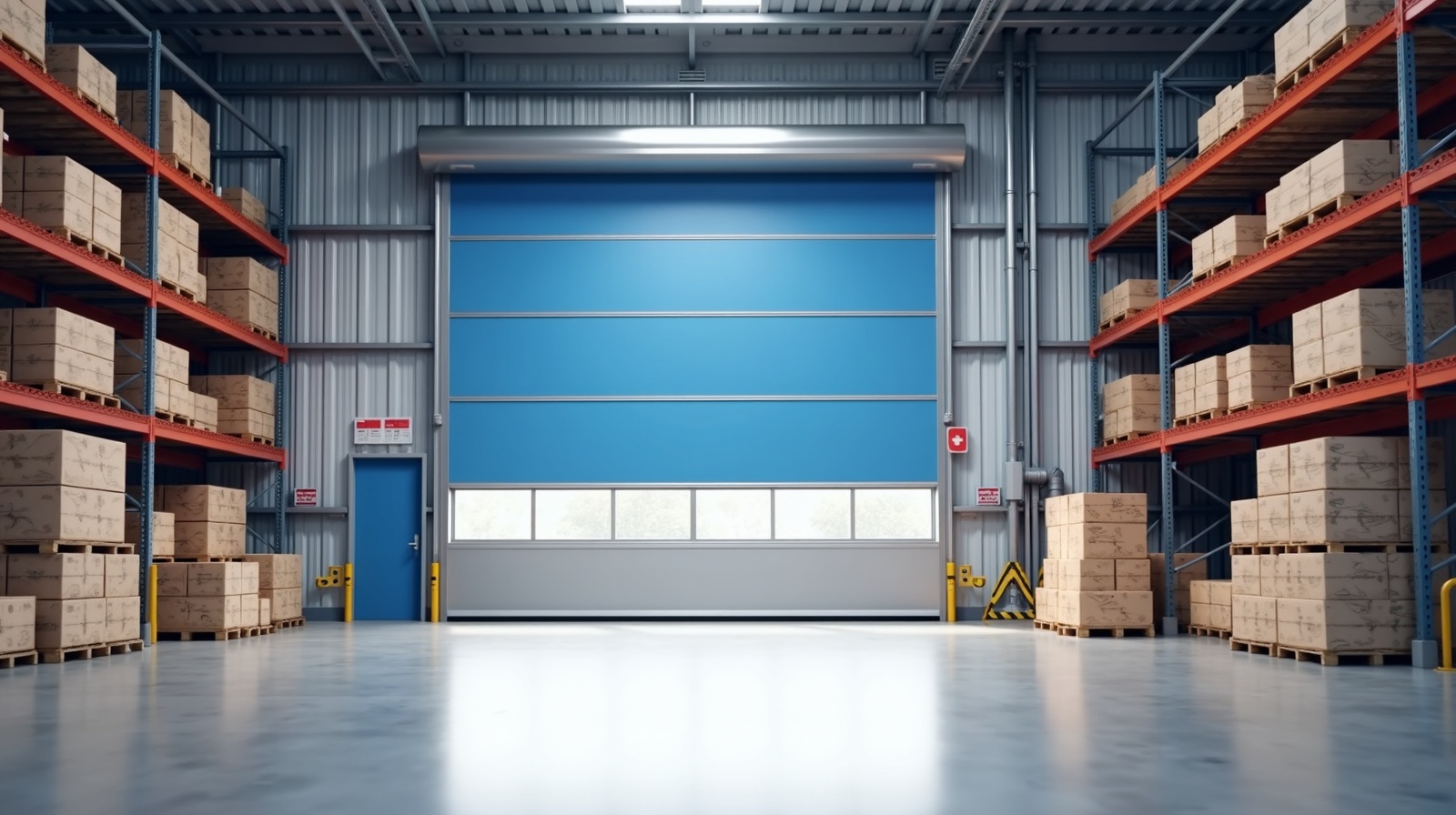
A high-speed door for logistics, also known as a fast acting door or rapid roll door, is a power-operated door with a flexible curtain that opens in seconds at busy transfer points and closes again as soon as the vehicle has passed. In a warehouse, forklifts, tugger trains, pallet trucks and pedestrians often use the same opening several hundred times a day. Every second a door stays open longer than necessary costs throughput, lets in draughts and adds to the heating or cooling load of the building.
Which door is right in a logistics building depends on where it is installed. At loading bays with dock shelters and dock levellers, sectional doors are the norm, because they stay open during loading and the docked lorry closes off the opening. High-speed doors come into their own wherever vehicles drive through the door: at transitions between goods-in, storage, order picking and dispatch, at access points to outdoor storage yards and at transitions to temperature-controlled zones. How high-speed doors compare with sectional doors and roller shutters is explained in the overview What is a high-speed door?.
The difference lies in speed. Depending on type and size, high-speed doors open at around 1.5 to 3 m/s, while a conventional roller shutter stays below 0.5 m/s and a sectional door runs at around 0.2 m/s. In purely arithmetical terms, ignoring acceleration and braking, a high-speed door 4 m in height clears the opening in roughly 1.3 to 2.7 seconds; a roller shutter needs more than 8 seconds and a sectional door around 20 seconds. When you compare quotations, check how the opening speed is stated: it is usually measured at the bottom edge of the curtain.
A good warehouse door is therefore not a stand-alone product but part of the material flow concept. Of all the industrial doors on a site, it is usually the one that opens most often, so door type, activation, safety devices and control are matched to vehicles, cycle rates and zones. If you are responsible for several transfer points across a site, the page for operations managers shows how to specify doors consistently.
Requirements in this application
- High cycle rates: typically several hundred cycles a day at central transfer points, more than 500 in multi-shift operation
- Opening without stopping for forklifts, tugger trains and automated guided vehicles (AGVs)
- Safe mixed traffic of pedestrians and industrial trucks
- Zone and climate separation between goods-in, storage, order picking and dispatch
- High availability despite the risk of impact in dense forklift traffic
- Clear opening dimensions matched to mast, overhead guard and load
- Interfaces to conveyor systems, AGV fleet control or the fire alarm system
Typical challenges at the door opening
The most common problem at warehouse door openings is the door as a bottleneck. If it opens too slowly, forklift drivers brake, wait or drive into a curtain that is not yet fully open. The result is impact damage to curtain and guides and, in the worst case, a blocked passage. Almost as common is the opposite reaction: a slow door is switched to permanently open. Traffic flows, but the separation of zones, dust, noise and temperature is lost, and packing and picking stations near the door suffer from draughts.
Mixed traffic makes matters worse. Pedestrians use the vehicle opening as a shortcut, cross traffic in front of the door triggers a radar field that is set too wide, and an opaque curtain hides oncoming traffic. Tugger trains pose a challenge of their own: the control must not interpret the gap between two trailers as a clear passage. Automated guided vehicles, in turn, need an unambiguous release signal before they enter. These risks are managed by combining technical measures at the door with organisational rules from the operator’s risk assessment, as described in the following sections.
The right solution
For internal transfer points with high cycle rates, a PVC high-speed door or a particularly lightweight clear curtain door is the first choice. The lightweight curtain allows high speeds, and a frequency inverter starts it smoothly and brakes it under control, which protects drive and mechanics over many load cycles. Crash protection with automatic re-insertion absorbs minor impacts, and transparent vision panels make oncoming traffic visible in good time.
On the building envelope, for example at the access to an outdoor storage yard or at hall doors used by lorries, you need a wind-resistant outdoor high-speed door. The key figure is the wind resistance class to EN 12424 (class 0 to 5), selected according to door size and the exposure of the façade. A proven approach is to combine a sectional door or roller shutter as night closure with a high-speed door for daytime operation in the same opening: the solid door provides security and insulation, the fast door provides throughput.
Activation determines efficiency. An induction loop reacts only to metal and opens specifically for forklifts and tugger trains; a radar with direction detection also detects people and ignores cross traffic; pull-cord switches and radio remote controls are used for deliberate opening. AGVs request the door via an interface and only enter after the feedback signal has confirmed the fully open position. A light curtain and a safety edge protect the opening, and traffic lights control two-way traffic. You can select activation and safety devices for your door in the configurator.
| Requirement | Solution at the door | Benefit |
|---|---|---|
| High cycle rates at internal transfer points | Lightweight PVC or clear curtain with frequency inverter | Short open time, smooth running, less wear |
| Forklifts without stopping | Induction loop in front of and behind the door | Opens only for vehicles, no false triggering by pedestrians |
| Mixed pedestrian and vehicle traffic | Radar with direction detection, light curtain, separate pedestrian door | Pedestrians are detected and have their own route |
| Tugger train with several trailers | Occupancy detection via light curtain and loops, adapted hold-open time | Door closes only after the last trailer |
| Automated guided vehicles | Interface to AGV fleet control with open-position feedback | Vehicle enters only when the door is fully open |
| Forklift impact | Crash protection with automatic re-insertion | No downtime after a minor impact |
| Two-way traffic and limited visibility | Traffic light control and vision panels in the curtain | Clear right of way, fewer collisions |
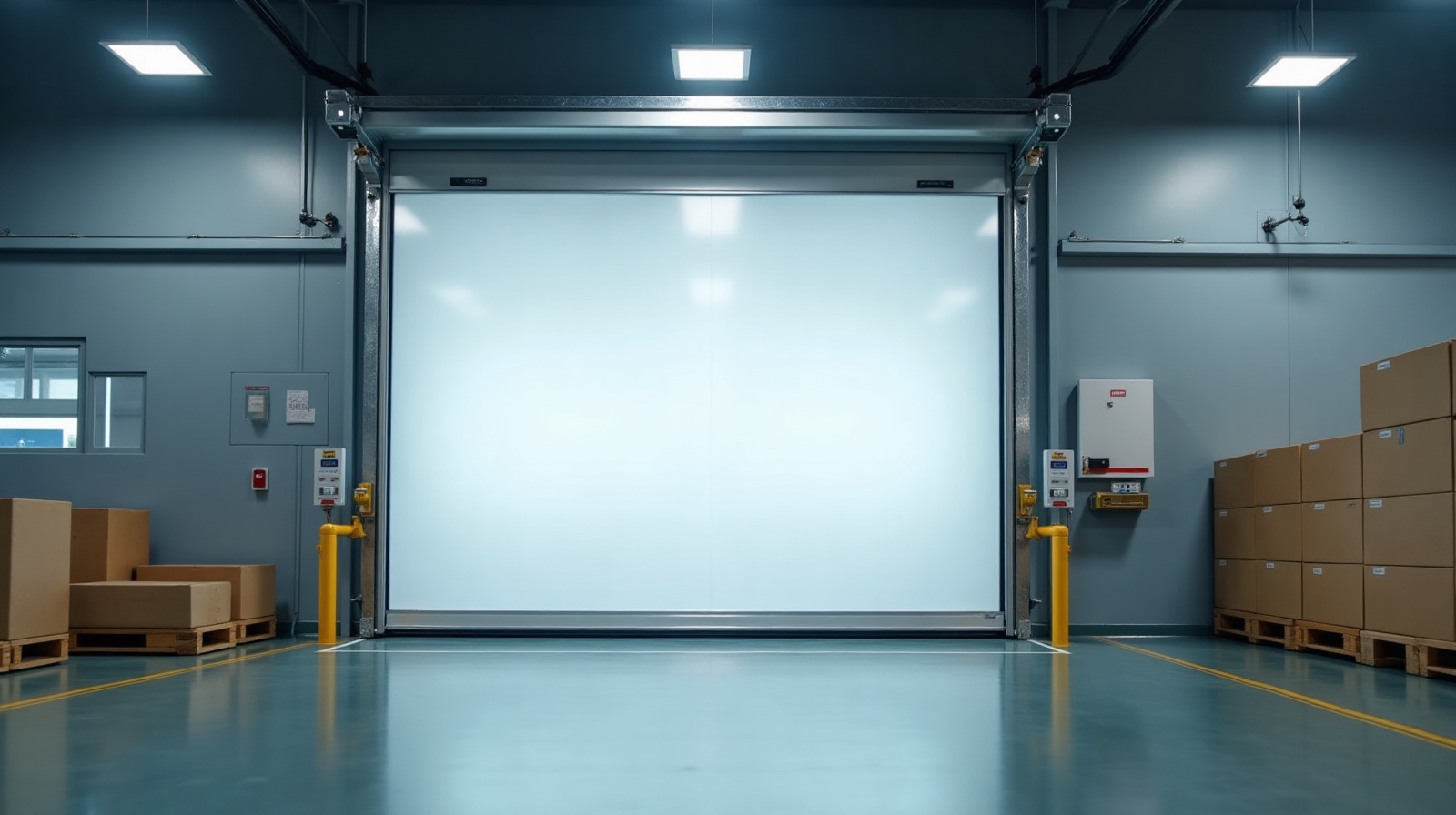
Configure a high-speed door for logistics and warehousing
Configure nowBenefits for your operation
- Throughput without congestion at the door opening
- Lower heating and cooling losses thanks to short open times
- Fewer draughts at packing and picking stations
- Clean separation of goods-in, storage, order picking and dispatch
- High availability thanks to crash protection and a low-wear drive
- Greater safety in mixed traffic with light curtain, traffic lights and vision panels
- Ready for automation: integration of AGVs and conveyor systems
Planning and installation
Planning starts with the traffic, not with the door. Count the passages in the peak hour, record vehicle types and directions of travel, and check whether pedestrians also use the door. A common planning approach for the clear width is the widest vehicle or load plus a lateral safety clearance, often around 0.5 m on each side; check this against the requirements for traffic routes in the national workplace regulations of the country of installation. For the clear height, the highest point of mast, overhead guard or load counts, plus a margin.
Structurally, headroom and side room are decisive: the drum and drive sit above the opening, the guides at the sides. In logistics buildings, sprinkler pipes, crane runways, lighting and racking often compete for this space, so it pays to check early. The floor must be level in the door area so that the bottom edge seals tightly. Induction loops are cut into the floor, so reinforcement and joints need to be clarified in advance. A power supply close to the door is required for the drive.
The door is delivered direct from the factory and installed by your installer, either your own maintenance team or a local door installer; the documentation for installation and operation is supplied with the door, as described under Delivery and installation. Fire compartments call for particular care: a high-speed door is not a fire-resisting closure. If the transfer point lies in a fire wall, an approved fire door or fire shutter is required in addition, and the high-speed door is positioned and controlled so that it never obstructs the closing path of the fire closure. The fire safety strategy for the building sets out the details. In existing buildings, high-speed doors can usually be mounted in front of the existing opening, often without altering the reveal.
Regulations and standards
High-speed doors are power-operated doors and fall under the product standard EN 13241, which is the basis for CE marking and the declaration of performance. Safety in use is covered by EN 12453, for example protection against crushing and shearing and the permissible closing forces. For external doors, the resistance to wind load is stated to EN 12424 in classes 0 to 5. EN 12635 deals with installation and use, including the information that the installer hands over to the operator.
In operation, inspection and maintenance follow the manufacturer’s instructions and the national workplace regulations in the country of installation; at high cycle rates, shorter maintenance intervals make sense. The work is carried out by your installer or a maintenance provider of your choice. EU workplace rules also generally require a clearly marked pedestrian door in the immediate vicinity of doors intended mainly for vehicle traffic, unless pedestrians can pass through safely. The basis for all measures is the operator’s risk assessment.
Cost-effectiveness
In the warehouse, a high-speed door pays off first and foremost through throughput. An example calculation: if a door saves just five seconds of waiting or braking time per passage, that adds up to around 33 minutes of vehicle time a day at 400 passages, at a single door. Across several doors and shifts, this becomes capacity that is available without additional forklifts or drivers.
Energy and availability come on top. Air exchange at an opening increases with the open time. A door that closes immediately after each passage instead of standing permanently open noticeably reduces heating and cooling losses. Crash protection and a low-wear drive prevent unplanned downtime, which in tightly scheduled processes usually costs more than the repair itself. The factors that determine the investment are explained on the page High-speed door cost.
Recommended equipment
Typical sizes in this application: 3,000 × 3,500 mm to 5,000 × 5,000 mm. All common sizes are listed under High-speed door sizes.
Checklist for your enquiry
- Location and purpose of each door: internal transfer point, building envelope or transition to a temperature-controlled zone
- Clear width and height and the highest vehicle or load height; the common high-speed door sizes provide orientation
- Cycle rate: passages in the peak hour and per day, shift pattern and planned growth
- Vehicles: counterbalance forklifts, reach trucks, pallet trucks, tugger trains with train length, automated guided vehicles
- Pedestrian traffic: do employees walk through the door, or is there a separate pedestrian door?
- Climate and wind: temperatures on both sides; for external doors, the façade orientation and wind exposure
- Installation situation: headroom, side room, obstacles such as sprinklers or crane runways, floor condition, location in a fire wall
- Control: preferred activation, interfaces to AGVs, conveyors or the fire alarm system, emergency opening in the event of a power failure
Suitable door types
Frequently asked questions
Which door is best for logistics?
That depends on where it is installed. At busy internal transfer points and access routes, a high-speed door is the right solution because it opens in seconds and closes again immediately. At loading bays with dock shelters, sectional doors are the norm. On the building envelope, a sectional door or roller shutter as night closure is often combined with a high-speed door for daytime operation.
How fast does a high-speed door open in a warehouse?
Depending on type and size, at around 1.5 to 3 m/s, measured at the bottom edge of the curtain. In arithmetical terms, a door 4 m high is therefore open in roughly 1.3 to 2.7 seconds. A conventional roller shutter stays below 0.5 m/s, a sectional door at around 0.2 m/s.
How many cycles a day can a high-speed door handle?
High-speed doors are built for high cycle rates. At central transfer points in logistics, 200 to 500 cycles a day are typical, and more in multi-shift operation. What matters is a drive and curtain designed for the load, a frequency inverter and maintenance intervals based on the actual number of cycles.
How does a high-speed door open automatically for forklifts?
Most often via an induction loop in the floor that reacts only to vehicles, or via a radar with direction detection that also detects people. Radio remote controls and pull-cord switches complement automatic activation where the door is to be opened deliberately. In no case does the driver need to stop or get off.
Does a high-speed door work with tugger trains and AGVs?
Yes, if the control is designed for it. With tugger trains, occupancy detection via light curtain and loops keeps the door open until the last trailer has passed. Automated guided vehicles request the door via an interface and only enter once the door reports that it is fully open.
How safe is a high-speed door in mixed traffic with pedestrians?
High-speed doors must meet the requirements of EN 12453: a light curtain monitors the opening, and the safety edge stops or reverses the door on contact. Organisational measures such as a separate pedestrian door, floor markings, vision panels in the curtain and traffic light control for two-way traffic add further safety.
What happens if a forklift hits the door?
With crash protection, the curtain is released from the guide in a controlled way and re-inserts itself automatically on the next cycle. As a rule, the door remains operational without a technician having to attend. After heavier impacts, guides, curtain and safety devices should nevertheless be checked by your installer or maintenance provider.
How much does a high-speed door for a warehouse cost?
The price depends mainly on size, door type, indoor or outdoor installation, wind resistance class, curtain design and equipment such as activation, crash protection and interfaces. Flat-rate prices therefore say little. Put your door together in the configurator and receive a quotation for your situation; the main price factors are explained under High-speed door cost.
Configure your high-speed door and request a quote
Choose size, curtain, drive and accessories in a few steps. You receive a non-binding quotation.