Door type
Freezer door
A freezer door is a high-speed door with an insulated curtain and a heated frame that tightly separates chilled and frozen areas from warmer zones without icing up. It keeps open times short and keeps the cold where it belongs.
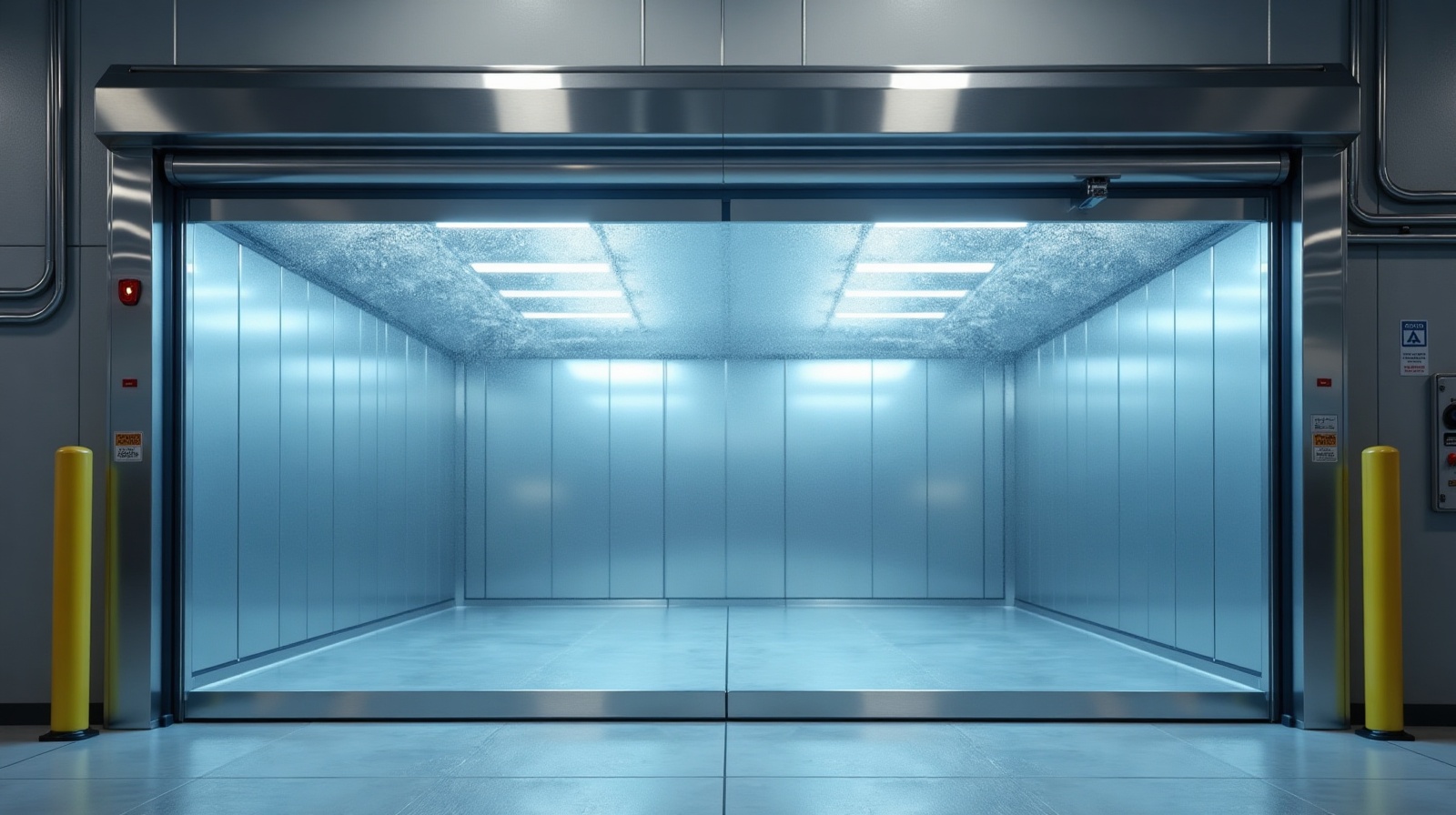
A freezer door is the type of high-speed door designed for continuous operation at the cold boundary – typically between a building at positive temperature and a freezer area at around −18 to −28 °C. At this boundary, warm, humid air meets ice-cold components. The moisture condenses and freezes in the guides, on the seals and on the floor. A standard door would freeze up here or damage its curtain. Anyone looking for a high-speed door for cold rooms and cold stores therefore needs a dedicated design.
The freezer door solves this problem with three coordinated elements: a freezer curtain with an insulating intermediate layer, heating of the frame, guides and bottom seal, and cold-flexible seals all round. Speed comes on top: the shorter the door stays open, the less moisture enters the cold area in the first place.
The economic lever lies in refrigeration energy. Every cubic metre of warm, humid air that flows into the freezer room has to be cooled and dehumidified. The moisture settles as frost on the evaporators and forces additional defrost cycles. A freezer door limits this ingress at source – as a single door or as part of an airlock with two high-speed doors. This makes the door a key component of cold store technology. How freezer doors are used across the entire operation of a cold store, from the cold chain to loading, is shown on the page high-speed doors for cold storage.
Key features
- Insulated, multi-layer curtain with an insulating intermediate layer
- Frame heating on side frames and guides to prevent icing
- Heated bottom seal, with additional curtain heating depending on version
- Cold-flexible seals at header, sides and floor
- Designed for continuous operation, typically at −18 to −28 °C
- Opening speed typically around 1.5 to 2 m/s, depending on size
- Frame galvanised, powder-coated or in 304 stainless steel
How it works
An opening cycle on a freezer door takes only a few seconds. A radar detector, an induction loop or a radio signal from the forklift triggers the opening. The drive with frequency inverter accelerates the insulated curtain quickly, coils it up above the opening and brakes it gently before the upper end position. As soon as the vehicle has passed and the light curtain reports the opening clear, the door closes again after a short hold-open time.
The heating works independently of the opening cycle. Heating elements in the side frames, guides and bottom seal keep the components in contact with the cold side above freezing point. Any condensate that still forms stays liquid instead of freezing in the guide. Many versions control the heating via a temperature sensor, so that only as much heat is used as necessary.
During the open phase, an effect occurs that every cold store door has to counter: cold, heavy air flows out of the freezer room at the bottom of the opening, while warm air flows in at the top. This exchange starts immediately and increases with open time and temperature difference. Fast cycles on a freezer door are therefore not a convenience feature but the most important measure against cold loss and ice formation.
Design and components
The curtain of a freezer door consists of at least two layers of PVC fabric with an insulating intermediate layer, such as an air chamber in a double membrane or a foam layer. The fabric is cold-flexible so that it does not become brittle at sub-zero temperatures and crack when coiling. Compared with a single-layer PVC curtain, whose U-value is usually above around 5 W/m²K, the insulation significantly reduces heat transfer through the closed surface.
The frame heating sits in the side frames and guides, often as self-regulating heating cable. Heat is applied where ice would block the movement: side guides, bottom seal and, depending on the version, the header area. On some doors, the bottom bar of the curtain is heated as well. The barrel shaft and drive sit above the opening; where possible, the motor and control unit are placed on the warm side.
Tightness is ensured by cold-flexible seals all round: brush or lip seals at the sides, a header seal at the top and an elastic, heated floor profile that compensates for minor unevenness. Depending on the environment, the frame is made of galvanised or powder-coated steel; in the food sector it is often made of 304 stainless steel with smooth, easy-to-clean surfaces. Hygiene requirements in food production are covered on the food industry page.

Technical data
| Feature | Guide value |
|---|---|
| Opening speed | typically approx. 1.5 to 2 m/s, depending on size and curtain |
| Closing speed | approx. 0.5 to 1 m/s, matched to the safety equipment |
| Cold side temperature | chilled approx. 0 to +8 °C, frozen approx. −18 to −28 °C |
| Curtain and insulation | multi-layer insulated, cold-flexible; heat transfer well below single-layer PVC |
| Heating | side frames, guides, bottom seal; usually temperature-controlled |
| Size range | typically approx. 2,000 × 2,500 mm to 4,000 × 4,500 mm |
| Headroom | approx. 400 to 650 mm, towards the upper end with a thick insulated curtain |
| Side room | approx. 150 to 250 mm per side, more on the drive side depending on motor position |
| Electrical connection | drive 230 V or 400 V depending on version, heating with its own connected load |
Guide values – exact figures depend on size, curtain and design.
Advantages
- No freezing of curtain, guides and bottom seal thanks to targeted heating
- Low cold loss due to short open times and an insulated door surface
- Less frost and ice on evaporators, floor and walls around the door
- High availability in multi-shift operation at the cold boundary
- Smooth forklift traffic without waiting at slow cold room doors
- Lower risk of slipping, as less ice forms in front of the door
- Suitable for airlock operation with a second door
Limitations
- Higher investment than an insulated high-speed door without heating
- Permanent power demand for the heating
- Insulation value of the door surface remains below that of a solid sliding cold store door
- Somewhat lower speed than very light indoor doors, as the curtain is heavier
- Heating, seals and curtain need regular checks, especially after an impact
Configure your freezer door to measure
Configure nowTypical applications
- Transition between picking area and freezer store
- Anterooms and loading areas in front of freezer rooms
- Freezing and frozen storage areas in food production
- Cold rooms above 0 °C with a very humid warm side
- Airlocks between ambient, chilled and frozen zones
- Temperature-controlled warehouses with several cold zones
What to consider when choosing
The most important selection question is: how cold is the cold side, and how humid is the warm side? If the cold area is permanently below freezing point, heating of the guides and bottom seal is essential. In chilled areas above 0 °C, an insulated high-speed door without heating is often sufficient – unless a very humid warm side causes the components to ice up anyway.
The second criterion is the cycle rate. With many passages per hour, every second of open time counts; this is where a frequency inverter, precise activation and a short hold-open time pay off. With very heavy traffic or a large temperature difference, an airlock of two doors or a temperature-controlled anteroom is often more economical than a single door.
Third, environment and traffic determine the equipment: in the food chain, a stainless steel frame with smooth surfaces makes sense, and with dense forklift traffic a curtain with crash protection, provided the chosen version offers it. Narrow down temperature, dimensions and equipment in the freezer door configurator.
Planning and installation
Freezer rooms are often built from sandwich panels with an insulating core, which can only take limited point loads. The door is therefore fixed via a sub-frame or reinforcements without creating new thermal bridges. Whether it sits in front of the wall or in the reveal, and on which side, is determined project by project. The space required above and beside the opening is explained on the sizes page.
The floor around the door must be level so that the heated floor profile seals tightly; ice ridges or edges at the cold boundary would otherwise prevent complete closing. In addition to the supply for the drive, the connected load of the heating must be planned for. Retrofitting in existing cold stores is often possible if wall construction, headroom, side room and electrics are surveyed carefully in advance.
Include the humidity on the warm side in your planning. A temperature-controlled, preferably dry anteroom or an airlock relieves the door considerably. For your enquiry, you should know the temperatures on both sides, the cycle rate, the vehicle types and the clear opening size. The door is delivered direct from the factory by freight forwarder; installation, electrical connection and commissioning are carried out by your installer, ideally one with experience of panel walls and cold stores – see delivery and installation.
Typical sizes
2,000 × 2,500 mm to 4,000 × 4,500 mm. Enter your exact size in the configurator, together with curtain, colour, drive and accessories. Common sizes are listed under High-speed door sizes.
Safety and standards
The freezer door is also a power-operated door and must meet the product standard EN 13241 and the safety-in-use requirements of EN 12453. This includes a safety edge and, as a rule, a light curtain that monitors the door area without contact. In the cold area, sensors and safety edges must be suitable for low temperatures and must not ice up.
For power failures, the door needs an emergency opening, for example by hand crank, chain hoist or backup battery. Anyone working in a freezer room must be able to leave it safely at any time; this is usually ensured by a separate personnel door with internal release. A high-speed door does not automatically replace this exit – the deciding factor is the risk assessment under the national workplace regulations in the country of installation.
Maintenance and service life
Power-operated doors must be inspected by a competent person before first use and at regular intervals – according to the manufacturer’s instructions and the national workplace regulations in the country of installation, with shorter intervals at high cycle rates. On a freezer door, checking the heating is essential: if a heating element fails, the door can quickly freeze up. Checks cover heating circuits, temperature sensors, seals, curtain, guides, drive and safety devices.
Wear parts are mainly the curtain, seals and floor profile. A damaged insulated curtain loses insulating effect, and a torn seal lets in moisture that builds up as ice. Inspection and maintenance are carried out by your installer or a local maintenance provider; a fixed schedule avoids downtime. Spare parts are available on request.
Cost and price factors
The price of a freezer door is determined mainly by size, curtain construction, extent of heating, frame material, drive and safety equipment. An airlock, a stainless steel frame, additional sensors and fixing to panel walls increase the effort. Installation by your installer is a separate cost item on your side.
The calculation is made over the service life: the investment is offset by saved refrigeration energy, fewer defrost cycles, less ice around the door and avoided breakdowns. With high cycle rates at the freezer boundary, the heated version therefore generally pays off better than a cheaper door that ices up. The price factors are explained on the page high-speed door cost; a non-binding quotation is available via the configurator.
Compared with other door types
Compared with an insulated PVC high-speed door, the freezer door additionally has heating of the frame, guides and bottom seal, plus cold-resistant seals. The insulated door without heating is sufficient in chilled areas above 0 °C or between heated and unheated buildings. As soon as there is permanent frost, the freezer door is the right design.
An insulated sliding cold store door insulates better when closed but opens much more slowly, which makes it more suitable as a night or weekend closure. Many cold stores combine both: the sliding door for long closing periods, the freezer door for ongoing traffic. A PVC strip curtain is at most a supplement in freezer areas, because it never closes tightly.
| Criterion | Freezer door | Insulated high-speed door | Sliding cold store door (insulated) |
|---|---|---|---|
| Opening speed | approx. 1.5 to 2 m/s | approx. 1.5 to 2.5 m/s | much slower |
| Continuous operation in frost | yes, heated | no, risk of icing | yes, with frame heating |
| Insulation when closed | good | good | very good |
| Cycle rate | high | high | low to medium |
| Cold loss during passage | low | low | higher due to long open time |
| Behaviour on impact | flexible curtain, crash protection depending on version | flexible curtain, often with crash protection | rigid door leaf, impact damage possible |
| Typical role | ongoing traffic at the freezer boundary | chilled areas above 0 °C, climate zones | night and weekend closure |
Other door types
Frequently asked questions
What is a freezer door?
A freezer door is a high-speed door with an insulated curtain and a heated frame for the transition into chilled and frozen areas. Heating of the guides and bottom seal prevents condensate from freezing. The insulation reduces cold loss through the closed door surface.
Why does a freezer door need heating?
At the cold boundary, moisture from the warm air condenses and freezes on guides, seals and floor. Without heating, the door would become stiff, freeze up or damage its curtain. Heated side frames and a heated bottom seal keep the movement free, even in multi-shift operation.
What temperatures is a freezer door suitable for?
Freezer doors are typically designed for freezer areas of around −18 to −28 °C, as is usual in frozen food stores. Suitability for even lower temperatures must be clarified for each project. Besides the cold side, the humidity on the warm side also matters.
How fast does a freezer door open?
Depending on size and curtain, a freezer door typically opens at around 1.5 to 2 m/s. The insulated curtain is heavier than a single-layer one; a drive with frequency inverter largely compensates for this. In freezer areas, a short open time is the most effective measure against cold loss.
Which door is suitable for a cold store?
For cold rooms above 0 °C, an insulated high-speed door without heating that closes tightly and runs fast is often sufficient. Freezer rooms need a freezer door with heated guides, a heated bottom seal and cold-flexible materials. For long closing periods, many operators add an insulated sliding cold store door.
How much power does the heating of a freezer door need?
The heating output depends on door size, temperature difference and version and is stated in the quotation. Compared with the refrigeration capacity of a freezer store it is small, especially as temperature-controlled heating only works when needed. The power demand is offset by avoided icing damage and lower cold losses.
Is a freezer door suitable for an airlock?
Yes. Two doors with mutual interlocking form an airlock in which both are never open at the same time. This handles the temperature step in two stages and further reduces cold loss and ice formation. The airlock must be large enough for the longest vehicle to fit inside completely.
How often does a freezer door need maintenance?
Inspection intervals follow the manufacturer’s instructions and the national workplace regulations in the country of installation; with high cycle rates, shorter intervals are advisable. On a freezer door, heating circuits, temperature sensors and seals are an essential part of every check, because a heating failure quickly leads to freezing. The work is carried out by your installer or a maintenance provider.
Configure your high-speed door and request a quote
Choose size, curtain, drive and accessories in a few steps. You receive a non-binding quotation.