Application
High-speed doors for industry and manufacturing
An industrial high-speed door for manufacturing is a power-operated door with an opening speed of around 1.5 to 3 m/s that separates production, storage and dispatch without slowing material flow. The short open time keeps heat, dust and noise in their respective zones.
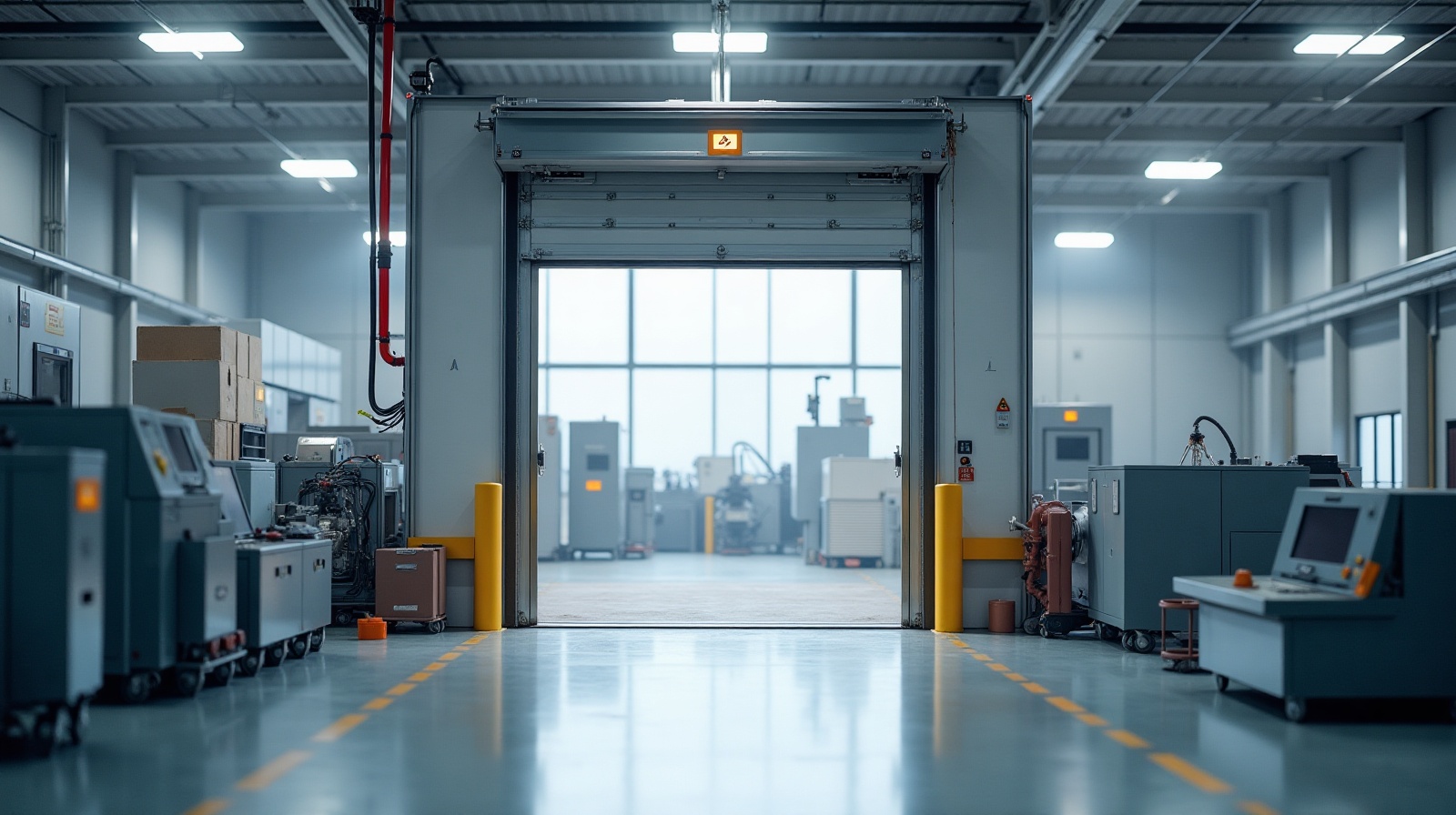
Industrial high-speed doors resolve a conflict of objectives: a production hall needs open routes for forklifts, tugger trains and automated guided vehicles, but closed boundaries for heat, dust, noise and draughts. A high-speed door opens only for the duration of the passage and then closes again immediately. Each zone therefore remains separated for most of the day, even though traffic flows unhindered.
Hardly any plant is uniform. Goods-in, raw material storage, machining, paint shop, assembly, packaging and dispatch each have their own requirements for temperature, cleanliness and noise level. At every transition between these areas there is a door opening, and each one is a potential leak. The task a high-speed door performs in a production hall therefore depends on the individual transition, not on the hall as a whole. Of all the industrial doors on a site, these internal doors are usually the ones that open most often.
A conventional roller shutter opens at less than 0.5 m/s, a sectional door at around 0.2 m/s. A high-speed door, by contrast, reduces the open time per passage to a few seconds. An example calculation: with a door height of 4 m, a roller shutter running at 0.3 m/s needs around 13 seconds just to open, a high-speed door at 2 m/s around 2 seconds. With several hundred passages a day, the difference quickly adds up to one or more hours of open door area. A detailed comparison of door types is given in What is a high-speed door?.
High-speed doors for industry and manufacturing are almost always made to measure, because opening, headroom, side room and traffic differ at every transition. The range extends from the lightweight indoor high-speed door with PVC curtain for high cycle rates to the insulated, wind-resistant outdoor high-speed door on the building envelope. High-speed doors are also widespread in the chemical industry, in foundries and in woodworking, there with adapted materials and seals.
Requirements in this application
- Separation of production, storage and dispatch without congestion in the material flow
- Short open times for low heating costs and stable climate control in the hall
- Containment of dust, chips, paint mist and noise between zones
- Draught-free workplaces near the door
- High cycle rates and availability in two- or three-shift operation
- Safe passage in mixed traffic of forklifts, AGVs and pedestrians
- Interfaces to conveyor systems, AGVs and plant control
Typical challenges at the door opening
The most common problem at door openings in production is the door left standing open. In shift operation, slow doors are often kept permanently open, because otherwise every forklift has to wait. The consequences: warm air escapes under the roof through the stack effect, cold air flows in at floor level, workplaces near the door suffer from draughts, and dust or noise from machining spreads into assembly and dispatch.
Mechanical and chemical stresses add to this. Forklifts hit the curtain if it opens too late or closes too early, and chips, grinding dust or oil mist settle in the guides. In the chemical industry, aggressive media attack seals and profiles, and some areas are classified as explosion hazard zones. And where conveyor lines or automated guided vehicles pass through the door, it must work reliably in step with the plant: a door that misses a signal stops the whole line.
The right solution
For most internal transitions, a high-speed door with a flexible PVC curtain is the most economical solution. It is lightweight, opens quickly and, thanks to a self-repairing zip system, also withstands an impact: the curtain is released from the guide and re-inserts itself on the next cycle. A frequency inverter ensures smooth starting and braking and so protects mechanics and curtain at high cycle rates. This is why the PVC high-speed door is the workhorse among industrial doors.
At transitions with a temperature difference, for example between heated production and a cold warehouse or at the external wall, an insulated, double-walled curtain is added so that the door loses little heat even when closed. Where noise protection matters, for example between press shop and assembly, a spiral door is the quieter choice, because its slats run without contact in the spiral guide. For the building envelope with wind and lorry traffic, wind-resistant outdoor doors or a high-speed roller shutter are suitable.
The control determines whether the short open time is actually achieved in everyday use. Radar motion detectors and induction loops open the door in good time for forklifts, traffic light control regulates two-way traffic at narrow passages, and volt-free contacts connect the door to conveyor systems and AGVs. A light curtain in the door plane stops the closing movement as soon as people, vehicles or conveyed goods are in the opening.
| Requirement | Solution at the door | Benefit |
|---|---|---|
| Zone separation at high cycle rates | Indoor door with PVC curtain, typically 1.5 to 3 m/s depending on size | Material flow without waiting, zones remain separated |
| Reducing heating costs at the external wall | Insulated curtain, tight guides and bottom seal | Less heat loss when open and closed |
| Noise between machining and assembly | Spiral door or damped end stop with frequency inverter | Quieter running, calmer neighbouring areas |
| Dust and chips | Brush or lip seals, smooth profiles, well-maintained guides | Less particle transfer, lower wear |
| Forklift traffic with impact risk | Self-repairing curtain, impact protection in front of the frames | No downtime after an impact |
| Conveyor systems and AGVs | Signal exchange via volt-free contacts, door-open feedback | Synchronised operation without line stoppage |
| Mixed traffic with pedestrians | Light curtain, traffic lights, separate pedestrian door | Safe routes, door opens only for vehicles |
Configure a high-speed door for manufacturing
Configure nowBenefits for your operation
- Lower heating costs in the industrial hall thanks to short open times
- Stable climate control in the hall, because zones remain separated
- Draught-free, quieter workplaces near the door
- Less transfer of dust and noise between production areas
- Continuous material flow without waiting at the door
- High availability thanks to a self-repairing curtain
- Clean integration with conveyor systems and AGVs
Planning and installation
Planning starts with a survey of all transitions: which zones adjoin each other, how large is the temperature difference, which vehicles pass through and how often? A main passage between production and storage with several hundred passages a day needs a different design from a rarely used secondary transition. Door type, curtain, drive and activation follow from these answers.
For the dimensions, headroom and side room matter as much as the clear opening. Depending on the system, the shaft and drive require around 400 to 650 mm above the opening, and the guide rails, and usually the drive, run at the side. In existing halls, these areas often clash with crane runways, sprinkler pipes, cable trays or racking, so measure up to the lowest obstacle; the common dimensions are listed under High-speed door sizes. Doors are usually mounted in front of the reveal; in existing plants, installation by your installer is best scheduled for periods of low production.
In automated processes, the door control belongs in the plant planning at an early stage. The position of the sensors, the signals between door and conveyor system or AGV, the behaviour in the event of faults and the question of whether the vehicle waits for a release in front of the door all need to be defined. If the opening lies in a potentially explosive atmosphere, an ATEX version matched to the zone classification is required. The door is delivered direct from the factory with the documentation for installation and operation, see Delivery and installation.
Regulations and standards
High-speed doors in industrial plants are subject to the product standard EN 13241 with CE marking and declaration of performance, and to EN 12453 for the safety in use of power-operated doors, which covers closing forces and protective devices such as light curtain and safety edge, among other things. For external doors, the wind resistance class to EN 12424 is added (class 0 to 5), and EN 12635 covers installation and use. As the operator, you have the door checked before it is first put into service and then at regular intervals, in line with the manufacturer’s instructions and the national workplace regulations in the country of installation; electrical safety checks can usually be carried out by your installer or maintenance provider at the same visit.
In potentially explosive atmospheres, such as those found in the chemical industry, in paint shops or where combustible dusts occur, the door must match the zone defined in the operator’s explosion protection document; equipment for these zones falls under the ATEX Directive 2014/34/EU. If the door is linked to conveyor systems or AGVs, the interface is part of the safety assessment of the overall installation.
Cost-effectiveness
In industry, a high-speed door pays off through three levers: energy, throughput and avoided downtime. The energy effect is greatest at doors with many passages and a large temperature difference, because every second of open time lets heat escape in winter and cooled air in summer. When it comes to reducing the heating costs of an industrial hall, the doors are usually at the top of the list.
In terms of throughput, every second that a forklift does not spend waiting in front of the door counts; across several vehicles and shifts, working hours quickly add up. Avoided downtime after impacts reduces follow-up costs. The payback period is determined by cycle rate, temperature difference, energy price and operating time. What influences the investment itself is explained under High-speed door cost; you can obtain a quotation for your transitions via the configurator.
Recommended equipment
Typical sizes in this application: 3,000 × 3,500 mm to 5,000 × 5,000 mm. All common sizes are listed under High-speed door sizes.
Checklist for your enquiry
- Transition and zones: Which areas does the door separate, and how large is the temperature difference?
- Clear dimensions: Width and height of the opening as well as headroom and side room on the left and right up to the nearest obstacle.
- Traffic: Vehicle types (forklift, tugger train, AGV, lorry), passages per hour and peak times.
- Installation location: Indoors or in the external wall; for external doors, the wind exposure of the façade.
- Environment: Dust, chips, oil mist, chemicals, moisture or a designated ATEX zone.
- Activation and interfaces: Radar, induction loop, pull-cord switch or signal from conveyor systems and AGVs.
- Safety: Pedestrian traffic, traffic lights, pedestrian door and emergency opening in the event of a power failure.
- Installation: Power supply at the installation site, mounting in front of or within the reveal, possible time window for installation by your installer.
Suitable door types
Frequently asked questions
Which high-speed door is suitable for industry?
For internal transitions, a PVC high-speed door with frequency inverter and self-repairing curtain is usually the most economical choice. At temperature boundaries and on the external wall, an insulated curtain is added, and in noise-sensitive areas a spiral door. The deciding factors are cycle rate, temperature difference and installation location.
How much heating cost does a high-speed door save in an industrial hall?
That depends on passages per day, door area, temperature difference and operating time; a flat figure would not be credible. The effect comes mainly from the shorter open time: a high-speed door opens at around 1.5 to 3 m/s, a roller shutter at less than 0.5 m/s. At heavily used doors with a large temperature difference, the door is often the largest single lever.
Does a high-speed door help with climate control in halls?
Yes. The short open time that retains heat in winter keeps cooled or dehumidified air in the hall in summer. This relieves the HVAC system and stabilises the temperature in temperature-controlled production areas.
Can a high-speed door work with automated guided vehicles (AGVs)?
Yes. The AGV registers via a signal, the door opens and sends the door-open feedback, and only then does the vehicle pass through. The signals run via volt-free contacts or, depending on the system, by radio. A defined behaviour in the event of faults is important so that neither door nor vehicle is blocked.
What happens if a forklift hits the high-speed door?
On a door with crash protection, the curtain is released from the guide in a controlled way instead of tearing and re-inserts itself automatically on the next cycle. Operation usually continues without a service call. Additional impact protection protects frames and drive.
Are there high-speed doors for the chemical industry?
Yes. Curtain, seals and frame must be resistant to the media used there; stainless steel frames and wipe-clean surfaces are often used. If the door is located in an explosion hazard zone, an explosion-protected ATEX version is also required, matched to the plant’s zone classification.
How often does a high-speed door in production need inspection?
In line with the manufacturer’s instructions and the national workplace regulations in the country of installation; at high cycle rates, more frequently. Safety devices, closing forces, mechanics and emergency opening are checked. The inspection is carried out by your installer or a maintenance provider.
Does a high-speed door reduce noise and dust between hall areas?
Yes, mainly through the short open time, because the opening is closed most of the time. For sound insulation when closed, a double-walled curtain is more effective than a single-walled one; tight guides and a bottom seal help against dust.
Configure your high-speed door and request a quote
Choose size, curtain, drive and accessories in a few steps. You receive a non-binding quotation.