Door type
Clear curtain door
A clear curtain door is a high-speed door whose curtain is made entirely or largely of transparent PVC film. It typically opens at 1.5 to 3 m/s and lets visibility and daylight through even when it is closed.
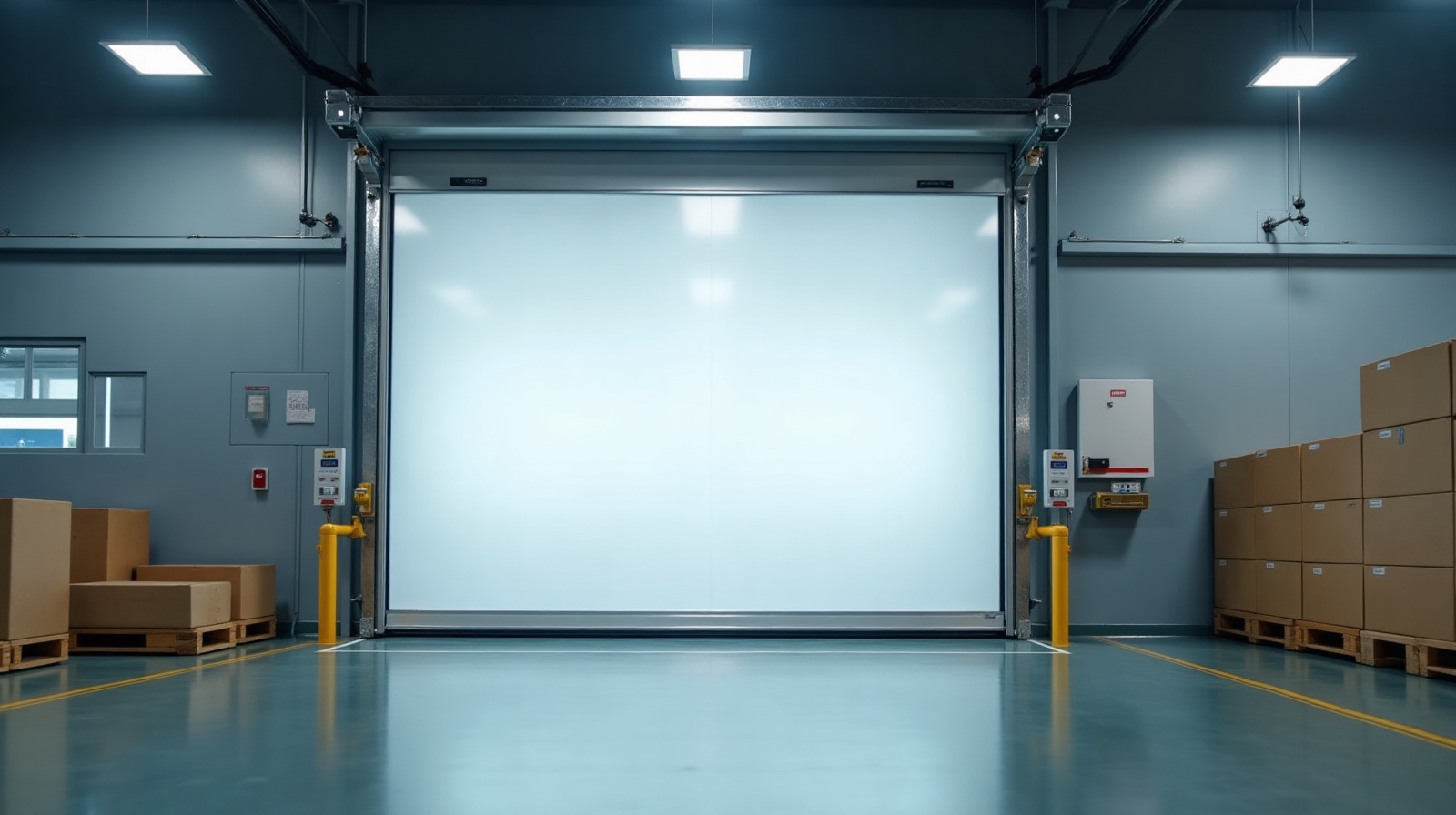
A clear curtain door, also known as a transparent high-speed door, differs from other high-speed doors mainly in the material of the door surface: instead of an opaque fabric, a clear, flexible PVC film closes the opening. Drive, winding shaft, guide rails and safety technology follow the familiar high-speed door principle, which is explained in our high-speed doors overview.
The transparent curtain solves three problems at busy openings. Drivers and pedestrians see oncoming traffic before the door opens. Daylight reaches adjacent sections of the hall. And neighbouring processes remain in view without the door having to stand open. Because film is lighter than a fabric curtain, the drive moves little mass – allowing high cycle rates with little wear.
The term is not used consistently. Some suppliers call any high-speed door with a plastic curtain a clear door. In agriculture and horticulture, a clear PVC door often means a simple roll-up sheet door that is wound up and down slowly by crank or gear motor. A clear curtain door in the sense of this page, by contrast, is a power-operated industrial door with a guided curtain, fast drive and safety devices according to EN 13241. Always compare offers on the basis of curtain material, speed and safety equipment.
The clear curtain door plays to its strengths inside the building: at transitions between production, warehouse and dispatch, at openings with forklift and pedestrian traffic, and wherever sections of a hall are to be separated but remain visible. For the building envelope with wind and weather, an outdoor high-speed door with a wind-reinforced curtain is the right design.
Key features
- Curtain made of transparent PVC film, fully or partially transparent
- Visibility and daylight even with the door closed
- Opening speed typically around 1.5 to 3 m/s
- Very low moving mass for high cycle rates in continuous operation
- Smooth, easy-to-clean surface
- Automatic re-threading after impact possible, depending on the system
- Designed mainly for indoor use and sheltered locations
How it works
A clear curtain door works in a short, automatically controlled cycle: trigger, open quickly, hold open briefly, close in a controlled way. It is usually triggered without contact by a radar motion detector, an induction loop in the floor, a pull switch or a signal from the conveyor system. A frequency inverter accelerates the winding shaft smoothly, and the film winds up above the opening in around one to three seconds, depending on the door height.
In the upper end position, the door stops via limit switches or an encoder and stays open only as long as the passage takes; the hold-open time is adjustable. During closing, a light curtain monitors the opening, and the safety edge in the bottom edge stops and reverses the door on contact. Closing is deliberately slower than opening so that the permissible forces are respected.
The difference from an opaque door shows even before it opens: anyone approaching a clear curtain door can see people and vehicles on the other side and brake in time. A radar with direction detection opens the door only for traffic that actually wants to pass through, not for cross traffic – which saves unnecessary cycles.
Design and components
A clear curtain door consists of two side frames with guide rails, the winding shaft with geared motor and frequency inverter, the film curtain with a flexible bottom edge, and the control unit. The frames are available in galvanised or powder-coated steel and, for hygiene and wet areas, in AISI 304 stainless steel. A zip system can re-thread the curtain into the guide automatically after an impact.
The film itself is decisive. Clear film without a base fabric is particularly light and see-through, but less tear-resistant than PVC fabric with a polyester base. For larger openings, mesh-reinforced films, horizontal stiffeners or mixed curtains are therefore used, in which fabric panels carry the load and film panels provide the view.
Clear film becomes stiffer at low temperatures. In unheated areas with frost, this must be taken into account when choosing the film; for chilled and freezer zones, a freezer door with an insulated, heated curtain is the right design.
Technical data
| Feature | Typical value |
|---|---|
| Opening speed | typically around 1.5–3 m/s, depending on size and drive |
| Closing speed | slower than opening, typically around 0.5–1.5 m/s |
| Size range | around 2,000 × 2,500 mm to 4,000 × 4,000 mm, varies by system |
| Curtain | transparent PVC film, optionally mesh-reinforced, or fabric with large film panels |
| Transparency | fully transparent or partially transparent with a vision area at eye level |
| Wind resistance class according to EN 12424 | indoors no requirement (class 0); outdoors only in sheltered locations with a low class |
| Thermal insulation | low; single-skin curtain with a U-value typically above around 5 W/(m²K) |
| Headroom | around 400–650 mm, depending on door height and system |
| Side room | around 150–250 mm per side, more on the drive side |
Guide values – exact figures depend on size, curtain and design.
Advantages
- Visibility of oncoming traffic reduces the risk of collision at openings
- Daylight between hall sections reduces the need for artificial lighting
- High cycle rates with little wear thanks to the lightweight film curtain
- Short opening times reduce draughts, dust and heat loss
- Processes in neighbouring areas remain in view
- Smooth film can be cleaned quickly
Limitations
- Film is sensitive to scratches and can become cloudy over time
- Lower tear resistance and wind stability than a fabric curtain
- Hardly any thermal insulation and no burglar resistance
- Clear film becomes stiffer in the cold and is unsuitable for freezer areas
- Full transparency is structurally limited on large openings
Configure your clear curtain door to measure
Configure nowTypical applications
- Hall passages with mixed forklift and pedestrian traffic
- Transitions between production, warehouse and dispatch with visual contact
- Halls with few windows, where daylight counts
- Order-picking and conveyor areas with high cycle rates
- Livestock buildings and machine sheds in agriculture in sheltered locations
- Hygiene areas with smooth surfaces and stainless steel frames
What to consider when choosing
The first question with a clear curtain door is: how much visibility do you need, and how large is the opening? For small and medium-sized doors indoors, a fully transparent curtain is suitable. For larger openings or rough operation, a partially transparent curtain with a vision area at eye level is more stable and durable. If an opaque curtain with individual vision panels is sufficient, take a look at the PVC high-speed door.
Next, temperature, location and traffic decide. Between areas at the same temperature, a single-skin film curtain is sufficient. With a significant temperature difference, an insulated curtain makes more sense, and on the external wall a wind-resistant door. At high cycle rates, a radar with direction detection and a light curtain pay off, and in hygiene areas a stainless steel frame.
In the configurator for clear curtain doors, you define dimensions, proportion of transparency, frame material, drive and activation and receive a non-binding quotation.
Planning and installation
For a clear curtain door, you typically need around 400 to 650 mm of headroom above the opening for the shaft and drive, and around 150 to 250 mm on each side for the guide rails, more on the drive side. Measure up to the lowest obstacle, such as a cable tray, sprinkler pipe or downstand beam. Our sizes page explains common dimensions and space requirements.
The door is usually mounted in front of the wall next to the opening, or within the reveal if it is deep enough. The floor under the bottom edge should be level so that the curtain seals tightly; an adapted floor seal compensates for larger unevenness. Depending on the version, the drive needs a 230 V or 400 V supply, and induction loops need a saw cut in the floor covering.
In existing buildings, a clear curtain door is easy to retrofit, for example at a previously open passage or in place of a worn PVC strip curtain. Clarify whether the opening forms part of an escape or rescue route and where pedestrians use a separate door. The door is delivered direct from the factory and installed by your installer – see delivery and installation.
Typical sizes
2,000 × 2,500 mm to 4,000 × 4,000 mm. Enter your exact size in the configurator, together with curtain, colour, drive and accessories. Common sizes are listed under High-speed door sizes.
Safety and standards
A clear curtain door is a power-operated door and must comply with the product standard EN 13241 and the requirements for safety in use according to EN 12453. These include a safety edge that stops and reverses the door on contact and, as a rule, a light curtain that monitors the door area without contact. Transparency improves visibility but does not replace these protective devices.
In a power failure, an emergency opening by hand crank, chain or backup battery clears the opening. Whether a door may be located on an escape route is governed by the workplace and fire safety regulations in the country of installation; for pedestrians, a marked door in the immediate vicinity is generally required.
Maintenance and service life
Power-operated doors must be inspected by a competent person according to the manufacturer's instructions and the national workplace regulations in the country of installation, typically at least once a year; at high cycle rates, a shorter interval is advisable. The checks cover the curtain, guides, drive, end positions and all safety devices.
With a clear curtain door, visual quality is an additional factor: clean the film regularly with water and a mild cleaning agent, without abrasives or solvents. Scratched or cloudy film is a wear part and can be replaced without replacing the door. Maintenance and replacement are carried out by your installer or a local maintenance provider – more on our delivery and installation page.
Cost and price factors
The price of a clear curtain door depends mainly on door size, proportion of transparency and equipment. Mesh-reinforced or fully transparent curtains, a stainless steel frame, a zip system and sensors such as radar, light curtain and traffic lights change the scope just as much as the installation situation on site. Flat-rate prices for clear curtain doors therefore say little; freight and installation by your installer are additional items on your side.
A clear curtain door pays off through shorter opening times, less collision damage, higher throughput and daylight in the hall. Which factors determine the price in detail is shown on our page on high-speed door cost; you can obtain a specific quotation via the clear curtain door configurator.
Compared with other door types
The clear curtain door and the PVC high-speed door share mechanics and safety technology; the difference lies in the curtain. The PVC door uses an opaque, polyester-reinforced fabric that is more tear-resistant, can be used outdoors with wind bars and can be insulated; visibility there comes from vision panels. The clear curtain door focuses on maximum transparency and minimum mass, making it the lightest version for indoor use.
The clear curtain door is often confused with the PVC strip curtain, because both are made of transparent PVC. However, the strip curtain has no drive: vehicles push through overlapping strips, gaps remain open and there are no safety devices. The clear curtain door opens without contact and closes the opening completely. Terms such as spiral door or high-speed roller shutter, on the other hand, describe the mechanism, not the curtain material.
| Criterion | Clear curtain door | PVC high-speed door | PVC strip curtain |
|---|---|---|---|
| Curtain | transparent PVC film, fully or partially transparent | PVC fabric, opaque, optionally with vision panels | overlapping PVC strips without drive |
| Visibility through the closed door | very good | only through vision panels | good, as long as the strips are clear |
| Opening | motorised, typically around 1.5–3 m/s | motorised, typically around 1.5–3 m/s | vehicles push through the strips |
| Sealing and climate separation | good, closes completely | good, can be insulated | low, gaps remain open |
| Robustness and wind stability | medium, mainly for indoor use | high, suitable outdoors with wind bars | low |
| Safety devices | light curtain, safety edge | light curtain, safety edge | none |
| Typical use | hall separation with visual contact | standard door indoors and outdoors | secondary passages |
Other door types
Frequently asked questions
What is a clear curtain door?
A clear curtain door is a high-speed door with a curtain made of transparent PVC film. It typically opens at 1.5 to 3 m/s and lets visibility and daylight through when closed. Drive and safety technology correspond to those of other high-speed doors.
What is the difference between a clear curtain door and a PVC high-speed door?
Both use the same mechanics but differ in the curtain. The PVC high-speed door has an opaque, tear-resistant fabric and, with wind bars, is also suitable for outdoor use. The clear curtain door is lighter and see-through, but more sensitive to scratches and wind.
Clear curtain door or PVC strip curtain – which is better?
For busy openings, the clear curtain door is the better solution because it opens without contact, closes completely and has safety devices. A strip curtain is less expensive, but always leaves gaps and quickly gets scratched by passing vehicles. More on our PVC strip curtain page.
How much does a clear curtain door cost?
There is no flat price, because every clear curtain door is made to measure. The price is determined mainly by door size, proportion of transparency, frame material, drive, sensors and the installation situation. In the configurator, you put together your door and receive a non-binding quotation.
Is a clear curtain door suitable for agriculture?
Yes, in sheltered locations, for example between livestock building, feed store and machine shed. The transparent curtain brings daylight into the building, and fast closing keeps draughts, birds and insects out; because of moisture and barn air, corrosion-protected frames are advisable.
Can a clear curtain door be used outdoors?
Only in sheltered locations with low wind loads. Film yields more to wind pressure than a fabric curtain with wind bars and can yellow under UV radiation. For the building envelope, an outdoor high-speed door with a suitable wind resistance class is the safe choice.
Does the film of a clear curtain door become cloudy over time?
Dust, scratches and UV radiation reduce transparency over the years. Regular cleaning with a mild cleaning agent and without abrasives keeps the film clear for considerably longer. If the film is scratched, it is replaced as a wear part without replacing the entire door.
How fast does a clear curtain door open?
Typically at around 1.5 to 3 m/s, depending on size and drive – so a three-metre-high door is open within a few seconds. By comparison, a conventional roller shutter usually stays below 0.5 m/s. For safety reasons, closing is somewhat slower.
Configure your high-speed door and request a quote
Choose size, curtain, drive and accessories in a few steps. You receive a non-binding quotation.