Door type
Spiral door
A spiral door is a high-speed door whose panel of rigid aluminium slats runs without contact into a spiral guide above the opening. It combines a typical opening speed of around 1.5 to 2.5 m/s with wind stability, insulation and quiet operation.
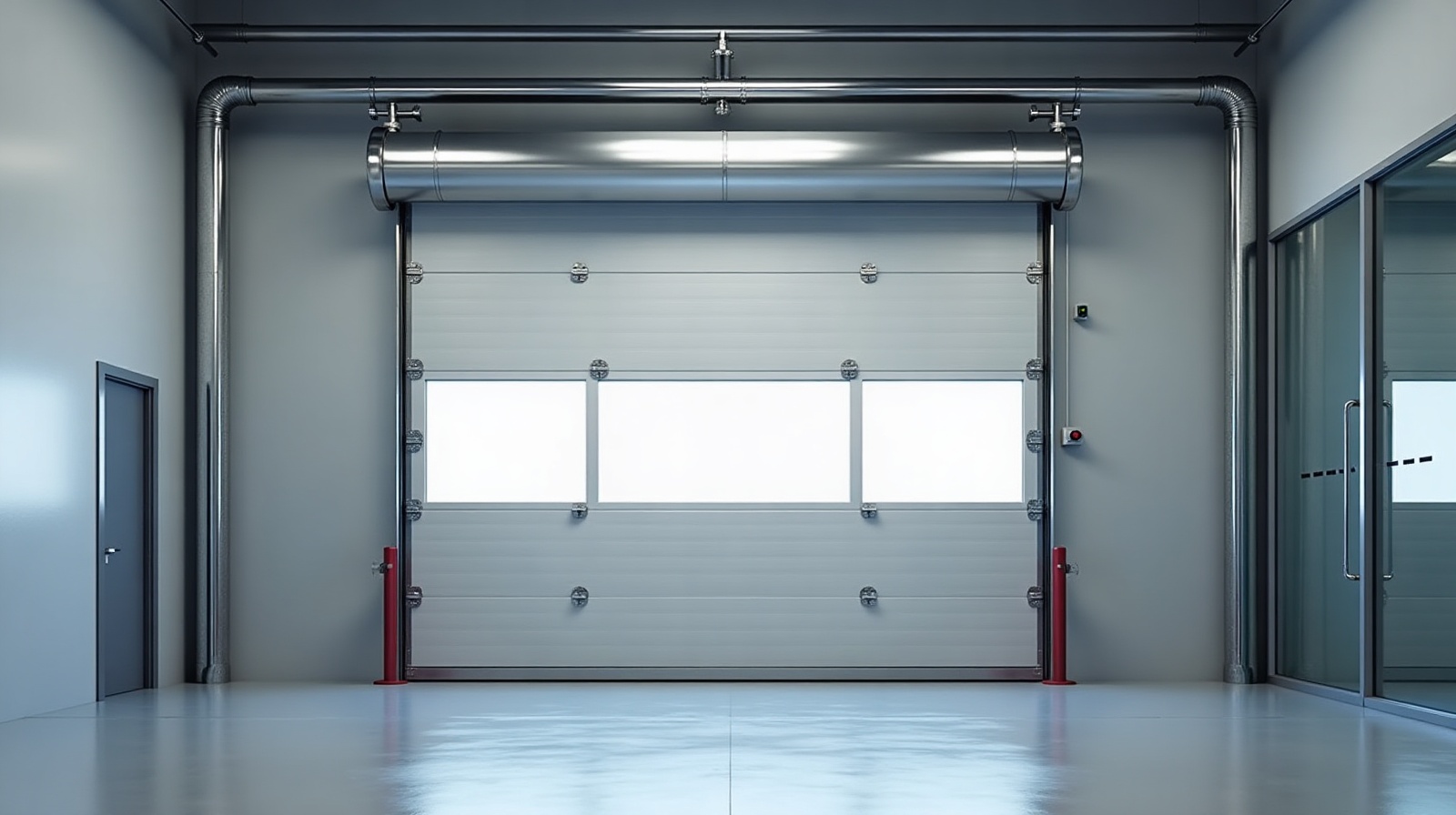
The spiral door, also known as a high-speed spiral door, is the rigid design among high-speed doors: instead of a flexible fabric, it moves a panel of hinged aluminium slats that is parked in a spiral guide above the opening when the door opens. Because the slats are held apart there, they do not rub against each other. This fundamentally distinguishes the spiral door from the conventional roller shutter, whose panel winds layer upon layer onto a shaft.
High-speed spiral doors close the gap between two worlds of doors. They open almost as fast as a PVC high-speed door, but offer the stability, insulation and appearance of an industrial door with solid panels. Insulated slats with a foam core, optional glazing and wind-resistant frames make the spiral door the preferred solution in the building envelope, at large openings and wherever a door has to be fast, quiet and permanently tight at the same time.
Typical locations are the external walls of logistics, production and workshop halls, vehicle halls and multi-storey and underground car parks. On many halls, a single spiral door can replace the common combination of a slow sectional door or roller shutter outside and a fast fabric door inside, because it combines speed and insulation in one door leaf.
This page brings together what you need for your decision: how it works, construction, key data, advantages and disadvantages, planning, safety, maintenance and cost factors. For an overview of all designs, see our high-speed doors page.
Key features
- Rigid panel of aluminium slats, uninsulated or with PU foam core
- Contact-free parking position of the slats in a spiral guide above the opening
- Opening speed typically around 1.5 to 2.5 m/s, depending on size and drive
- High wind resistance classes according to EN 12424, typically class 3 to 5 depending on door width
- Good thermal insulation with insulated slats
- Quiet, low-wear operation via a drive with frequency inverter
- Optionally with vision panels or glazed slats for daylight
How it works
Depending on door height, an opening cycle of the spiral door takes only a few seconds: an activation device detects the vehicle, the drive pulls the slat panel up into the spiral and, once the vehicle has passed, the door closes automatically. The signal usually comes from a radar motion detector, an induction loop in the floor, a pull switch or a radio remote control.
In the spiral guide, the slats run on a fixed track via rollers or sliding elements at their ends. Each slat has its own place there and does not touch the adjacent turn – unlike winding onto a shaft, where the diameter grows with each layer and surfaces rub against each other. The frequency inverter starts the panel smoothly, accelerates it to rated speed and brakes it in a controlled manner before the end position.
Closing takes place at reduced speed, typically around 0.5 to 1 m/s, so that the permissible closing forces are respected. A light curtain in the frames monitors the closing plane and stops or reverses the door as soon as it detects an obstacle. The hold-open time is adjustable, so the door stays open only as long as the passage requires.
Design and components
A spiral door consists of five assemblies: slat panel, side frames with guide, spiral console, drive with control unit, and safety and activation devices. The slats are usually double-walled aluminium profiles; insulated versions have a PU foam core and a thermal break between the inner and outer shell. The thicker the slat, the better it insulates.
For light and visual contact, individual slats can be designed as vision slats with transparent plastic windows. The slats are available powder-coated in RAL colours or anodised, the frames in galvanised steel, powder-coated or in AISI 304 stainless steel for wet and hygiene areas. Brush or lip seals in the frames, a lintel seal and a floor seal on the bottom edge ensure a tight closure.
The drive sits at the side of the spiral console and works as a geared motor with frequency inverter. The control unit in the control box next to the door processes activation and safety devices and, if required, integrates traffic lights, airlock circuits or the building management system.
Technical data
| Feature | Typical value |
|---|---|
| Opening speed | typically around 1.5–2.5 m/s, depending on door size and drive |
| Closing speed | reduced, typically around 0.5–1 m/s |
| Size range | commonly around 3,000 × 3,000 mm to 5,000 × 5,000 mm, other sizes depending on version |
| Wind resistance class (EN 12424) | typically class 3–5, depending on door width and slat profile |
| Door panel | aluminium slats, single-walled or double-walled with PU foam core, optionally glazed |
| Thermal insulation (U-value) | insulated slats around 1–2.5 W/m²K, depending on slat thickness, glazing and door size |
| Headroom | around 700–1,200 mm depending on door height; compact spiral shapes need less |
| Side room | around 200–400 mm per side, usually more on the drive side |
| Service life | designed for several hundred thousand to around 1 million load cycles, depending on version and maintenance |
Guide values – exact figures depend on size, curtain and design.
Advantages
- Short opening times even at the external wall thanks to typically 1.5 to 2.5 m/s
- Good thermal insulation when closed thanks to insulated slats
- High wind stability even with large door openings
- Quiet operation, suitable for noise-sensitive environments and sites near residential buildings
- Low wear, because the slats do not touch each other in the spiral
- Can replace the combination of external door and indoor high-speed door
- High-quality appearance, optionally with glazing for daylight
Limitations
- Higher investment than a PVC high-speed door or high-speed roller shutter
- Needs more headroom than a winding door with fabric curtain
- No self-re-threading after an impact; deformed slats must be replaced
- No integrated wicket door possible, so pedestrian access has to be planned separately
- Usually oversized for purely indoor use without insulation requirements
Configure your spiral door to measure
Configure nowTypical applications
- External doors on logistics, production and workshop halls
- Large and wind-exposed door openings
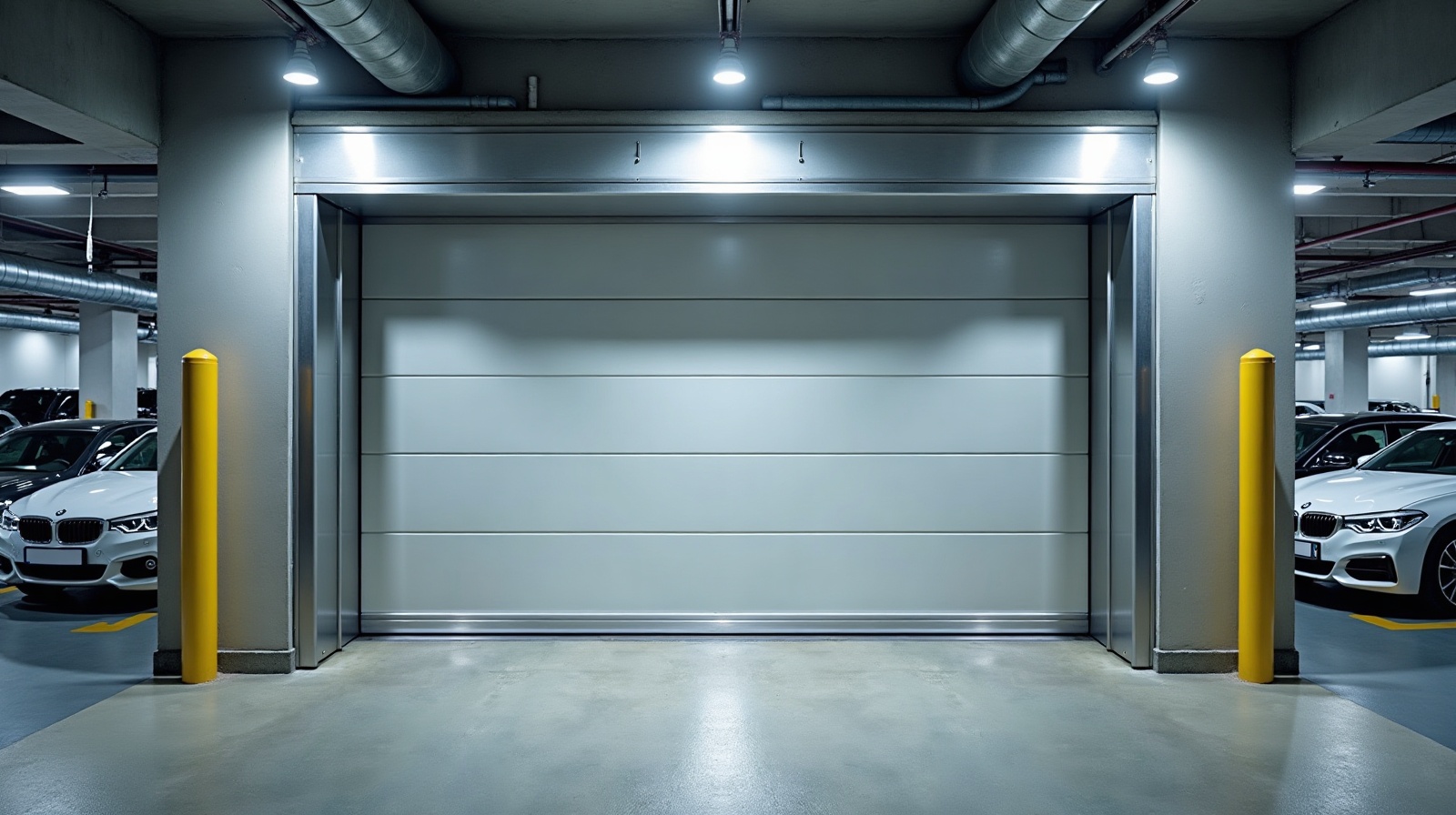
- Underground and multi-storey car parks, especially near residential buildings
- Heated or air-conditioned halls with insulation requirements for the building envelope
- Vehicle halls with frequent entries and exits
- Prestigious entrances, delivery zones and showrooms
What to consider when choosing
A spiral door is the right choice when an external door has to open frequently and at the same time insulate, close tightly and withstand wind. The higher the cycle rate and the greater the temperature difference between hall and outside air, the more the spiral technology pays off compared with a slow sectional door. Inside the hall without insulation requirements, by contrast, an indoor high-speed door with PVC curtain is usually the more economical solution.
Five criteria determine the right version: the wind resistance class for the site, the insulation requirement and thus the slat thickness, the need for light and visibility, the available headroom and the type of activation. With the wind resistance class, one class of reserve is worthwhile; the required class depends on the wind conditions at the site, the building height, the exposure of the façade and the door width.
For activation, induction loops for trucks and forklifts, radar for mixed traffic and radio or access control for underground car parks have proven themselves; at bottlenecks with two-way traffic, traffic lights control right of way.
Planning and installation
Headroom, side room and floor are the decisive dimensions for planning a spiral door. As a guide, the spiral console needs around 700 to 1,200 mm above the clear opening, depending on door height; compact spiral shapes need less. At the sides, allow around 200 to 400 mm per side for frames and drive, usually more on the drive side. How to record both dimensions correctly is shown on our sizes page.
The spiral door is generally mounted in front of the reveal on the inside of the wall; installation within the reveal is possible if it is wide and deep enough. The floor must be level and load-bearing so that the bottom edge seals tightly, because the floor seal can compensate for larger unevenness only to a limited extent. A fused power supply is provided at the control box for the drive, usually three-phase depending on the version.
In existing buildings, a spiral door can be retrofitted well if the headroom is sufficient: the old door is removed, the opening and fixing substrate are checked, and the new door is mounted in front of the wall. If the headroom is insufficient, a compact spiral shape, a high-speed roller shutter or structural adjustments are options. The door is delivered direct from the factory across Europe and installed by your installer – see delivery and installation.
Typical sizes
3,000 × 3,000 mm to 5,000 × 5,000 mm. Enter your exact size in the configurator, together with curtain, colour, drive and accessories. Common sizes are listed under High-speed door sizes.
Safety and standards
A spiral door is a power-operated door and must comply with the product standard EN 13241 and the requirements for safety in use according to EN 12453. Basic equipment includes a light curtain that monitors the closing plane without contact, supplemented by a safety edge depending on the version, and a fall arrest device that prevents the panel from dropping uncontrollably in the event of a defect.
In a power failure, the door can be opened by an emergency hand chain or hand crank, or optionally automatically via an emergency power supply. A wicket door cannot be built into the spiral panel; if the opening lies on an escape or rescue route, a separate side door is planned. Which emergency opening suits your opening can be clarified as part of your enquiry.
Maintenance and service life
Power-operated doors must be inspected by a competent person before first commissioning and then at regular intervals according to the manufacturer's instructions and the national workplace regulations in the country of installation, typically at least once a year; at high cycle rates, shorter service intervals make sense. The checks include the light curtain, closing forces, fall arrest device, drive, rollers, frames and seals.
Wear parts are mainly the rollers or sliding elements of the slats, seals, the floor profile and drive components. Because the slats do not rub against each other in the spiral, the panel itself remains intact for a long time, and damaged individual slats can be replaced. Service life depends on the number of load cycles, not on age. Inspection and maintenance are carried out by your installer or a local maintenance provider – more on our delivery and installation page.
Cost and price factors
The price of a spiral door is higher than that of a PVC high-speed door and depends mainly on door size, slat version, wind resistance class, glazing, drive, safety and control technology and the installation effort. Options such as stainless steel frames, special colours or an emergency power supply are added. Which factors apply in detail is shown on our page on high-speed door cost; freight and installation by your installer are cost items on your side.
The investment pays off through energy, throughput and service life: an insulated spiral door reduces heat losses at the external wall twice over – through short opening times and through the insulated surface when closed. Added to this are shorter waiting times for forklifts and trucks and a panel that hardly wears. You can obtain a non-binding quotation for your dimensions via the spiral door configurator.
Compared with other door types
The spiral door and the high-speed roller shutter both move a slatted panel, but store it differently: the high-speed roller shutter winds it layer upon layer onto a shaft, while the spiral door parks it without contact in the spiral. As a result, the spiral door offers higher speed, quieter operation, less wear and better insulation thanks to thicker slats; the high-speed roller shutter is less expensive and often needs less headroom.
Compared with the PVC high-speed door, the spiral door is stiffer, insulates better and withstands higher wind loads, but is more expensive and not self-repairing after an impact. Compared with the sectional door, it opens many times faster and needs no ceiling space for tracks, but depending on panel thickness insulates somewhat less. For outdoor doors with a flexible curtain, see the outdoor high-speed door.
| Criterion | Spiral door | PVC high-speed door | Sectional door |
|---|---|---|---|
| Opening speed | around 1.5–2.5 m/s | around 1.5–3 m/s | around 0.2 m/s |
| Door leaf | rigid aluminium slats | flexible PVC fabric | insulated panels |
| Thermal insulation | good with insulated slats | low, moderate when insulated | very good |
| Wind stability | high | medium, with wind bars | high |
| After an impact | slat replacement needed | often self-repairing | panel replacement needed |
| Space requirement | headroom for the spiral | little headroom | ceiling space for tracks |
| Typical use | external door with high cycle rate | indoor door with high cycle rate | external door, infrequent opening |
Other door types
Frequently asked questions
What is a spiral door?
A spiral door is a high-speed door with a panel of aluminium slats that runs without contact into a spiral guide above the opening. It typically opens at around 1.5 to 2.5 m/s and combines the speed of a high-speed door with the stability and insulation of an industrial door.
How fast does a spiral door open?
Depending on size and drive, high-speed spiral doors typically open at around 1.5 to 2.5 m/s and close at a reduced speed of around 0.5 to 1 m/s. A conventional roller shutter stays below 0.5 m/s, a sectional door at around 0.2 m/s.
What is the difference between a spiral door and a roller shutter?
With a roller shutter, the slatted panel winds layer upon layer onto a shaft and the slats rub against each other. With a spiral door, the slats run without contact into a spiral, which allows faster, quieter and lower-wear opening. In return, the roller shutter has a simpler design and is usually less expensive.
How much headroom does a spiral door need?
As a guide, the spiral console needs around 700 to 1,200 mm above the clear opening, depending on door height. Compact spiral shapes need less. The exact requirement is determined by a site survey of headroom, side room and obstacles under the ceiling, usually carried out by your installer.
Are spiral doors suitable for outdoor use?
Yes, outdoor use is where spiral doors excel. Depending on door width, the rigid slats typically achieve wind resistance class 3 to 5 according to EN 12424, and insulated slats and seals close the building envelope tightly. More on our outdoor high-speed door page.
How well does a spiral door insulate?
With insulated aluminium slats, spiral doors achieve U-values of around 1 to 2.5 W/m²K as a guide, depending on slat thickness, proportion of glazing and door size. A single-skin PVC curtain, by contrast, is usually above 5 W/m²K. For curtain doors with better insulation, see the insulated high-speed door.
How long does a spiral door last?
Depending on the version, spiral doors are designed for several hundred thousand to around one million load cycles. Because the slats do not touch each other in the spiral, the panel hardly wears; the parts that are regularly checked and replaced are mainly rollers, seals and drive components.
How much does a spiral door cost?
There is no flat price: size, slat version, wind resistance class, glazing, drive and accessories determine the price. Spiral doors cost more than PVC high-speed doors, but save energy and maintenance effort at the external wall. In the configurator, you put together your door and receive a non-binding quotation.
Configure your high-speed door and request a quote
Choose size, curtain, drive and accessories in a few steps. You receive a non-binding quotation.