Door type
Outdoor high-speed door
An outdoor high-speed door is a high-speed door in the building envelope, designed with wind bars, reinforced guides and weather-resistant materials for wind pressure according to EN 12424. It typically opens at 1.5 to 2.5 m/s.
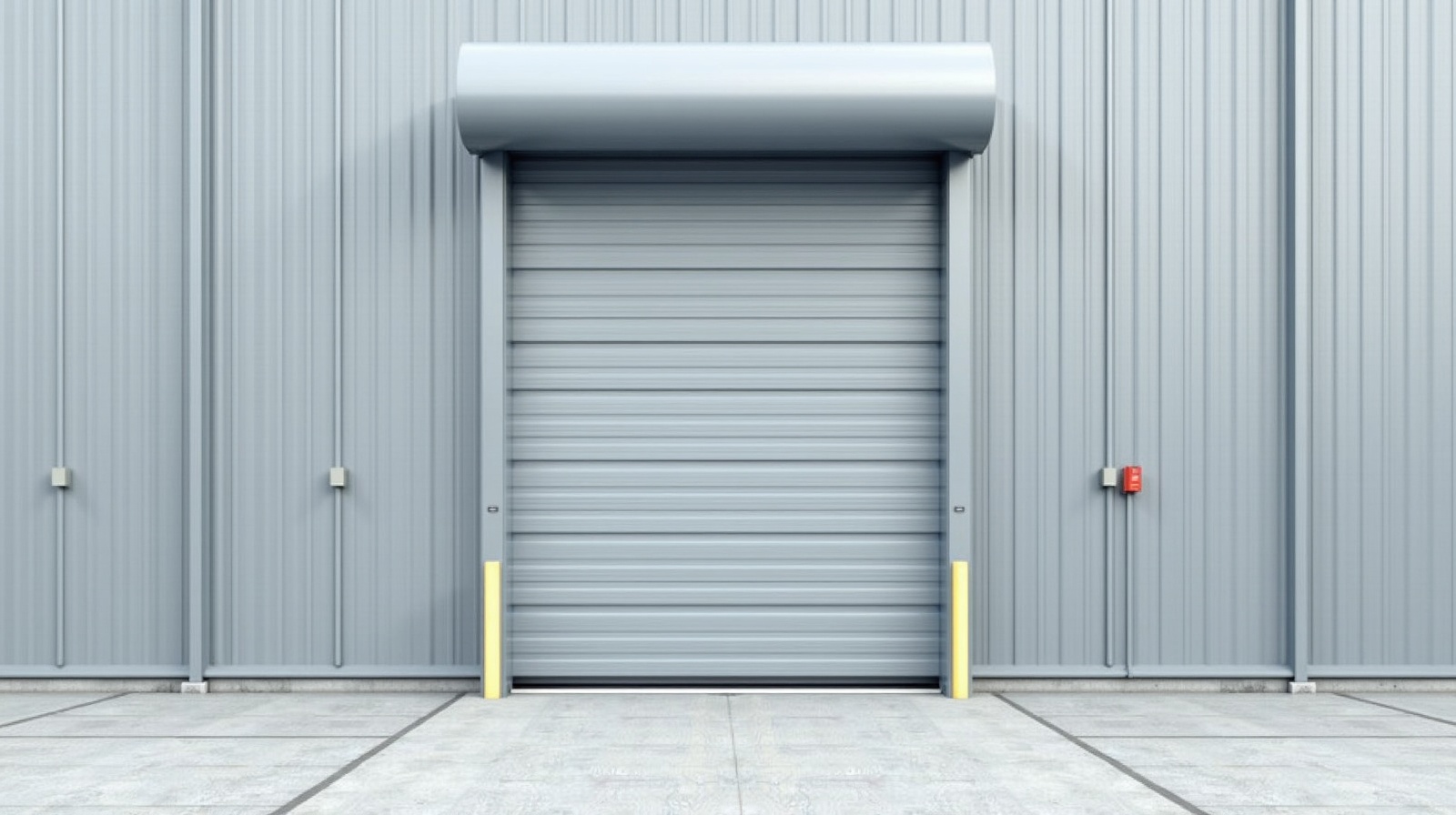
An outdoor high-speed door forms the boundary between the hall and the weather. Unlike an indoor door, it has to withstand wind pressure and suction, rain, frost and UV radiation over the long term and still close quickly after every passage. That is why it works with a heavier curtain, horizontal wind bars, deeper guide rails and a proven wind resistance class.
The speed advantage is retained. A wind-resistant high-speed door typically opens at 1.5 to 2.5 m/s, a sectional door at around 0.2 m/s and a conventional roller shutter usually at less than 0.5 m/s. Because the temperature difference between inside and outside is greatest at the external wall, every second of shorter opening time saves heating energy and keeps draughts, dust and rain out of the hall.
On this page, outdoor door means the design with a flexible, wind-reinforced curtain. For very large or highly exposed openings, the spiral door with aluminium slats and the high-speed roller shutter are also options.
Typical locations are hall doors in the façade with forklift and truck traffic, passages between buildings across the yard, and machine and workshop halls. How outdoor doors are used at loading points, ramps and access routes is described on the application page loading bays and access.
Key features
- Wind resistance class according to EN 12424, typically class 2 to 3, higher depending on size and bracing
- Horizontal wind bars in the curtain and reinforced guide rails
- UV- and weather-resistant PVC curtain, optionally with vision panels
- Corrosion-protected frames in galvanised steel or stainless steel
- Opening speed typically around 1.5 to 2.5 m/s
- Floor seal via a flexible bottom edge, side seals in the guides
- Optional insulated curtain and heated guides against icing
How it works
An outdoor high-speed door opens on a signal, winds the curtain and its wind bars onto a shaft above the opening, holds open briefly and closes in a controlled manner. In vehicle traffic, it is usually triggered by an induction loop in the floor, by radar or by a handheld radio transmitter from the vehicle. A frequency inverter accelerates the heavier curtain smoothly and brakes it before the end position.
When the door is closed, the wind presses on its surface or creates suction. The wind bars brace the curtain horizontally and transfer the forces into the side guide rails, which in turn pass them via the frame into the wall and floor. If the curtain edge does come out of the guide in a strong gust or an impact, a self-repairing zip system re-threads it on the next run.
The door closes more slowly than it opens. A light curtain and safety edge monitor the movement, and finally the flexible bottom edge settles on the floor and seals. Depending on the control system, a wind monitor can be integrated that moves the door into a defined, protective state during storms.
Design and components
An outdoor door consists of two frames with guide rails, the winding shaft with geared motor and frequency inverter, the wind-reinforced curtain with a safety edge in the bottom edge, and the control unit. For outdoor use, the curtain of tear-resistant PVC fabric is rather heavier, with typical weights of around 900 to 1,300 g/m². Wind bars made of aluminium or steel sit in pockets in the curtain and engage in the guides on both sides.
The comparable value for wind stability is the class according to EN 12424. The standard assigns test pressures: class 1 corresponds to 300 Pa, class 2 to 450 Pa, class 3 to 700 Pa and class 4 to 1,000 Pa, while class 5 stands for higher values. The number and strength of the wind bars, the guides and the anchoring depend on the class and the door width, because the free span grows with the width.
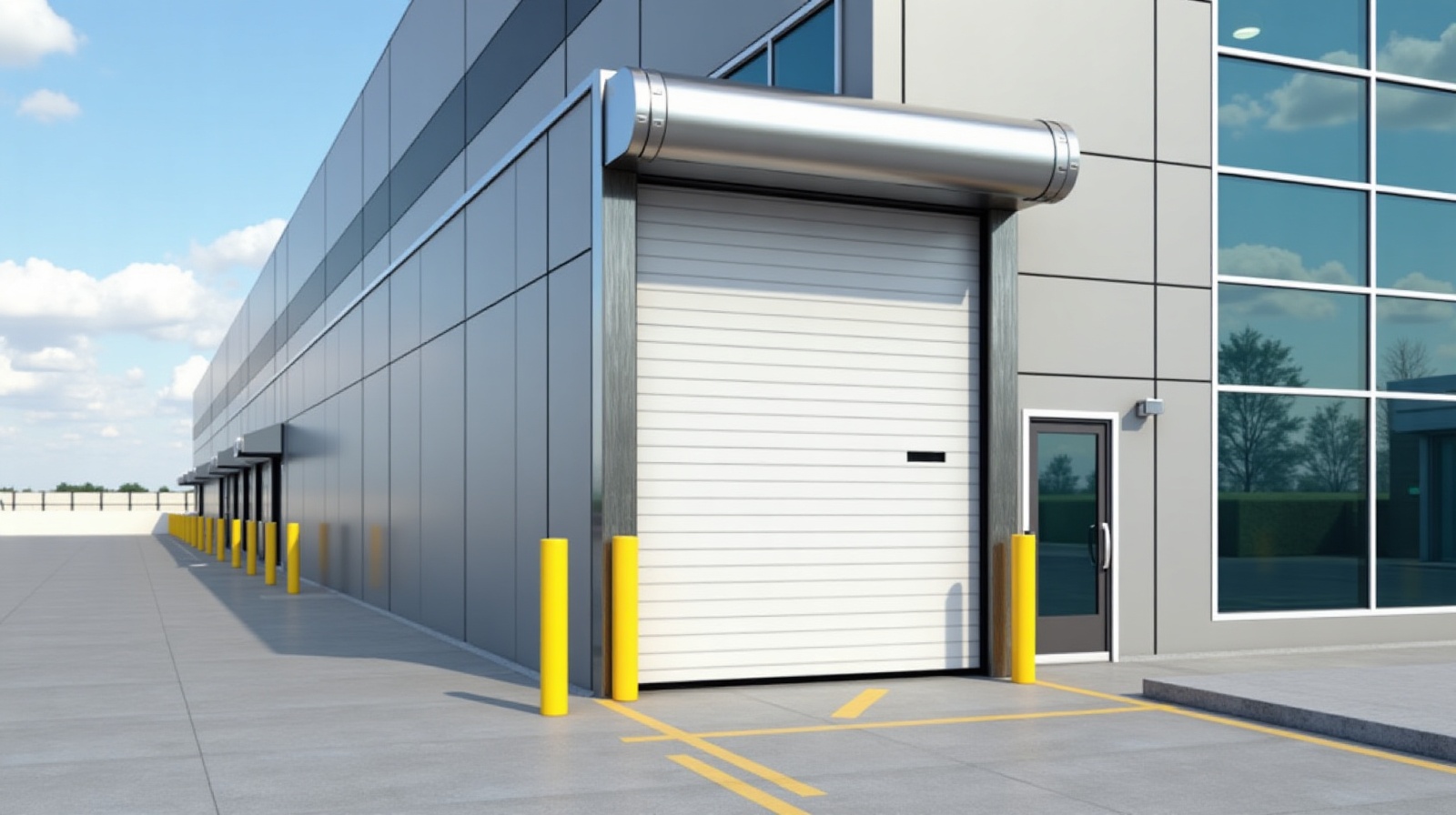
For the building envelope, further options are available: an insulated curtain or double membrane for better insulation, heated guide rails against icing, brush or lip seals at the sides and, for external mounting, a weather hood for the shaft and drive. The control unit and sensors are protected against moisture.
Technical data
| Feature | Typical value |
|---|---|
| Opening speed | typically around 1.5–2.5 m/s, depending on size and curtain weight |
| Closing speed | slower than opening, typically around 0.5–1.0 m/s |
| Size range | around 3,000 × 3,000 mm to 5,000 × 5,000 mm, larger sizes depending on the system |
| Wind resistance class according to EN 12424 | typically class 2–3, higher classes depending on size and bracing |
| Curtain | PVC fabric of around 900–1,300 g/m² with wind bars, optionally with vision panels or insulated |
| Thermal insulation | single-skin U-value typically above around 5 W/(m²K), considerably lower when insulated |
| Headroom | around 400–650 mm, towards the upper end for large doors with wind bars |
| Side room | around 150–250 mm per side, rather more on the drive side and with wind-resistant profiles |
| Service life | typically designed for several hundred thousand load cycles, with the curtain as a wear part |
Guide values – exact figures depend on size, curtain and design.
Advantages
- Short opening times reduce heating energy and draughts at the building boundary
- Wind-resistant even on exposed façades with the right wind resistance class
- High throughput at access points without waiting for the door
- Flexible curtain copes with impacts better than rigid panels
- Optionally insulated and frost-proof for heated halls
- Automatic activation from inside the vehicle
Limitations
- Lower thermal insulation than an insulated sectional door
- Hardly any burglar resistance; an additional closure is advisable at night
- Wind bars and stronger guides need more headroom and side room
- Operation is restricted in storms above the design class
- Weather increases the maintenance effort compared with an indoor door
Configure your outdoor high-speed door to measure
Configure nowTypical applications
- Hall doors in the façade with forklift and truck traffic
- Passages between buildings across the yard
- Transitions from outside into heated or air-conditioned halls
- Wash bays and workshops of vehicle fleets
- Machine sheds and livestock buildings in agriculture
- Second door behind a sectional door that stays open during the day
What to consider when choosing
The most important selection criterion is the wind resistance class. It depends on the wind conditions at the site as defined in Eurocode EN 1991-1-4 and its national annex, the terrain category, the building height, the orientation of the façade to the prevailing wind and the door size. For many outdoor doors in normal locations, class 2 or 3 is a practical choice; free-standing, tall or very wide doors need more reserve. If in doubt, choose one class higher.
Next come insulation, traffic and security. With a large temperature difference, an insulated curtain pays off; with frost, heated guides. In truck traffic, induction loops, radar and traffic lights make sense. If the opening has to be closed securely at night, combining the high-speed door with a sectional door or roller shutter is the better solution.
For very large openings, highly exposed locations or noise protection requirements, a spiral door is a robust alternative. In the configurator for outdoor high-speed doors, you enter dimensions, location, curtain and activation and receive a suitable, non-binding recommendation.
Planning and installation
Above the opening, allow typically 400 to 650 mm of headroom for the shaft and drive – rather more for large doors with many wind bars – and around 150 to 250 mm on each side for the guide rails. The door is usually mounted on the inside in front of the wall so that the frame and shaft are protected; mounted externally, it needs a weather hood. Because the wind forces are transferred via the guides into the wall and lintel, the fixing substrate must be designed for this – with sandwich panels or aerated concrete, often with an auxiliary steel structure. Common sizes and space requirements are summarised on our sizes page.
The floor in the door area should be level and load-bearing and slope slightly towards the outside so that no water stands at the bottom edge and freezes; a drainage channel in front of the door helps in heavy rain. The flexible bottom edge compensates for minor unevenness, an adapted floor seal for larger deviations. Depending on the version, the drive needs a 230 V or 400 V supply, and induction loops are cut into the floor surface.
In existing buildings, an outdoor high-speed door is often combined with an existing sectional door: the sectional door remains as the insulated night closure, while the high-speed door behind it handles traffic during the day. Because it then forms the weather seal, it should itself be wind-resistant. The track type of the sectional door, the position of shaft and drive and the coupling of the controls are planned together. The door is delivered direct from the factory and installed by your installer – see delivery and installation.
Typical sizes
3,000 × 3,000 mm to 5,000 × 5,000 mm. Enter your exact size in the configurator, together with curtain, colour, drive and accessories. Common sizes are listed under High-speed door sizes.
Safety and standards
As a power-operated door, an outdoor high-speed door is subject to the product standard EN 13241; the declaration of performance states the wind resistance class and, depending on the door, values for water tightness, air permeability and thermal transmittance. Safety in use is governed by EN 12453: the safety edge and light curtain prevent the door from closing on people or vehicles.
An emergency opening by hand crank, chain or backup battery clears the passage in a power failure. Next to a door used mainly for vehicle traffic, the workplace regulations in the country of installation generally require a clearly visible pedestrian door; escape and rescue routes are coordinated with the fire safety requirements. At access points with two-way traffic, traffic lights control the passage.
Maintenance and service life
Power-operated doors must be inspected by a competent person according to the manufacturer's instructions and the national workplace regulations in the country of installation, typically at least once a year; outdoor doors with high cycle rates or heavy wind exposure benefit from shorter intervals. In addition to the drive, end positions and safety devices, the checks cover the wind bars and their pockets, the guide rails for deformation, the curtain for UV damage and tears, and the floor and side seals.
Before winter, it is worth checking heated guides, drainage and induction loops. Curtain, seals and wind bars are wear parts and can be replaced individually; the frame, shaft and drive last considerably longer with regular maintenance. This work is carried out by your installer or a local maintenance provider – more on our delivery and installation page.
Cost and price factors
The price of an outdoor high-speed door is determined mainly by door size and wind resistance class, because both increase the number and strength of the wind bars, the guide profiles and the drive power. Further factors are the curtain (single-skin, insulated, with vision panels), corrosion protection of the frame, heated guides, sensors such as induction loop, radar and traffic lights, and the installation effort for auxiliary structures, weather hood and floor works, which your installer carries out and which are costed on your side.
The door pays off economically through lower heat losses at the building boundary, higher throughput and less collision damage. An overview of the price factors is given on our page on high-speed door cost; a non-binding quotation is available via the configurator.
Compared with other door types
Compared with the indoor high-speed door, the outdoor door is built more heavily: wind bars, stronger guides and weather-resistant materials cost a little speed, but they are what make the door suitable for the façade. Compared with an insulated sectional door, it opens around ten times faster and copes better with impacts, but insulates less when closed and offers hardly any burglar resistance. At heavily used external openings, the combination of both doors is therefore common.
For very large or particularly exposed openings, the spiral door and the high-speed roller shutter are the more robust alternatives; their slats or sturdier curtains absorb higher wind loads but are heavier and more complex. Loading points, ramps and access routes are covered on the application page for loading bays and access.
| Criterion | Outdoor high-speed door | Insulated sectional door | Spiral door |
|---|---|---|---|
| Opening speed | typically around 1.5–2.5 m/s | around 0.2 m/s | high, depending on version |
| Wind stability | typically class 2–3 with wind bars | high thanks to rigid panels | high thanks to aluminium slats |
| Thermal insulation when closed | low to medium, can be insulated | very good | medium, better with insulated slats |
| Behaviour on impact | curtain gives way, re-threading possible | panels dent, repair needed | slats may deform |
| Burglar resistance | low | high | higher than a curtain door |
| Cycle rate in continuous operation | very high | low to medium | high |
| Typical use | façade door with heavy traffic | loading, night closure | large, exposed or prestigious doors |
Other door types
Frequently asked questions
What wind resistance class does an outdoor high-speed door need?
That depends on the wind conditions at the site, the building height, the exposure of the façade and the door size. For many outdoor doors in normal locations, class 2 or 3 according to EN 12424 is a practical choice; free-standing, tall or very wide doors need more reserve. If in doubt, one class higher is the safe choice.
How wind-resistant is an outdoor high-speed door?
As resistant as its proven wind resistance class. According to EN 12424, class 3 corresponds to a test pressure of 700 Pa, which is roughly equivalent to the dynamic pressure at a wind speed of around 120 km/h. This is achieved with wind bars in the curtain, deep guides and suitable anchoring in the wall.
What is a wind bar on an outdoor door?
A wind bar is a horizontal aluminium or steel profile in the curtain that braces the door surface against wind pressure and transfers the forces into the guide rails. The number and strength of the bars depend on the wind resistance class and the door width.
Can a high-speed door replace a sectional door as an external door?
Yes, if speed and throughput are the priority. However, it does not match the insulation and burglar resistance of an insulated sectional door. The combination is therefore common: a sectional door as night closure with a wind-resistant high-speed door behind it for daytime traffic. Our high-speed doors overview compares the door types.
How well does an outdoor high-speed door insulate?
A single-skin PVC curtain typically has a U-value above around 5 W/(m²K) and therefore insulates little, but saves energy through its short opening time. With an insulated curtain or double membrane, heat transfer drops considerably, although a curtain door usually does not reach the value of an insulated sectional door. For higher requirements, see the insulated high-speed door.
Does an outdoor high-speed door work in frost and snow?
Yes, if it is equipped for it. Heated guide rails prevent moisture from freezing in the guide, a cold-flexible curtain stays pliable, and a fall in front of the door keeps meltwater away from the bottom edge. Drainage and induction loops should also be checked before winter.
What happens to the outdoor door in a power failure?
The door initially stays in its position. An emergency opening by hand crank, chain hoist or backup battery allows it to be opened without mains power. Which solution fits depends on the door size and the escape route situation.
How much does an outdoor high-speed door cost?
There is no flat price, because every outdoor door is designed to measure. Size, wind resistance class, curtain, frost protection, sensors and installation effort are decisive. In the configurator, you put together your outdoor door and receive a non-binding quotation.
Configure your high-speed door and request a quote
Choose size, curtain, drive and accessories in a few steps. You receive a non-binding quotation.