Application
High-speed doors for the food industry
A food industry high-speed door is an industrial door of hygienic design that separates hygiene and temperature zones with short open times and can be cleaned residue-free with foam and water, from meat processing to beverage bottling.
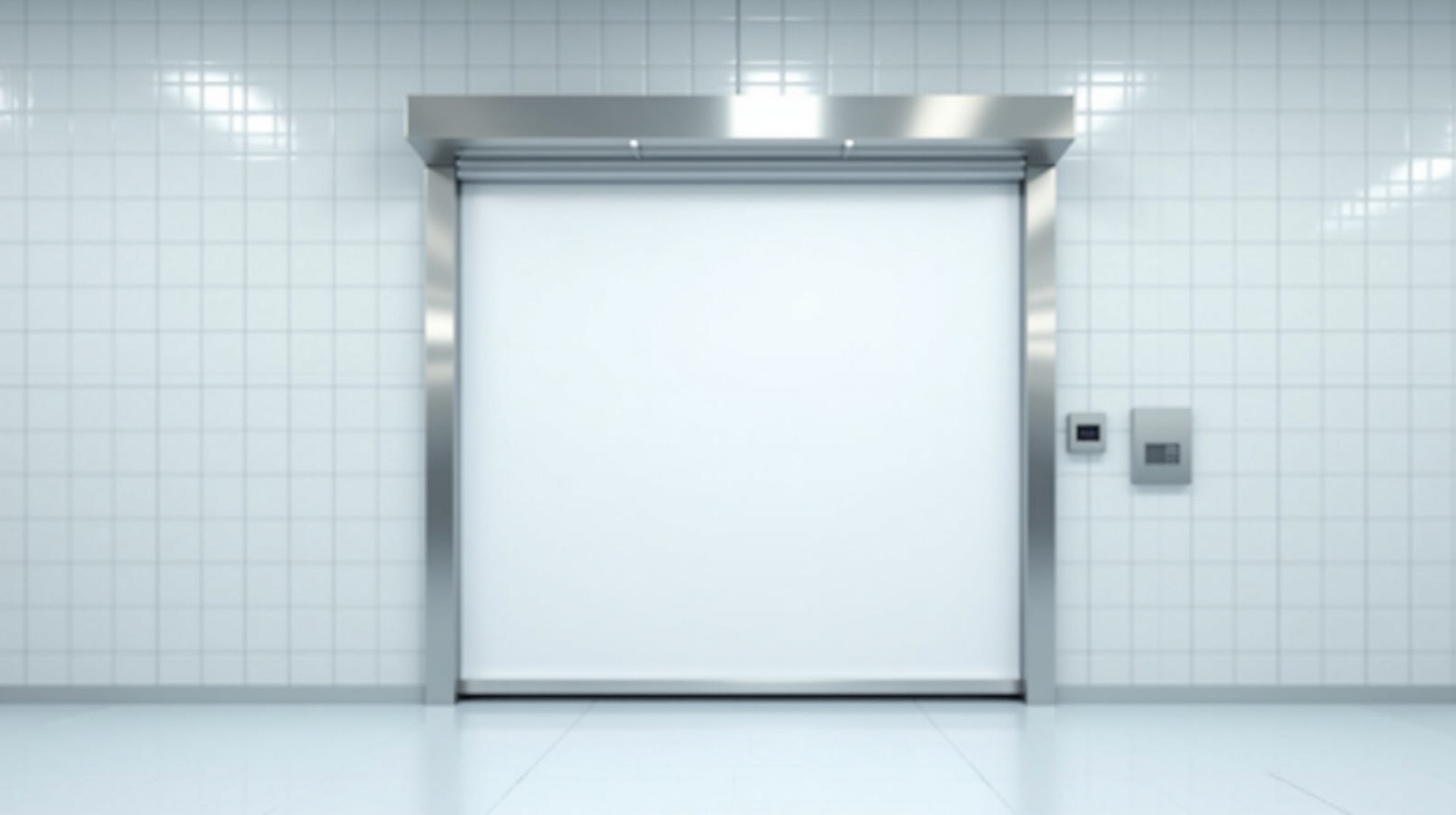
In food production, the door is part of the hygiene chain. It separates raw materials from processed products, chilled from ambient areas and production from loading and storage. A high-speed door for the food industry does this job because it typically opens at 1.5 to 3 m/s and closes again immediately after each passage. This keeps the exchange of air, moisture, dust and insects between zones to a minimum.
Hygienic design is decisive. Smooth curtains without pockets, frames and guides in stainless steel 304 (1.4301) and closed covers without horizontal ledges can be wet-cleaned and disinfected every day without corroding. Painted steel parts, open hollow sections or glass, on the other hand, have no place in areas close to the product, because they can become harbourage points for microorganisms or sources of foreign bodies.
High-speed doors are used in almost every sector of the food and beverage industry: meat and sausage processing, dairies and cheese production, bakeries, fruit and vegetable processing, confectionery, breweries, mineral water plants and beverage bottling. Depending on the sector, different stresses dominate: salt and fat in meat processing, alkaline and acidic cleaning agents in dairies, moisture and heavy pallet traffic in the beverage industry.
For a door in food production, this results in three equally important tasks: it must support hygiene in line with the plant’s HACCP plan, keep temperature zones stable and handle high numbers of forklift and pallet truck passages without waiting time. If one of these tasks is neglected, the door becomes a bottleneck or a hygiene risk. Chilled and frozen areas are covered in more detail on the page High-speed doors for cold storage.
Requirements in this application
- Smooth, low-porosity surfaces that withstand wet cleaning, with no dirt traps
- Corrosion-resistant frame and guides in stainless steel 304, or 316 where chlorides are present
- Clear separation of low-risk and high-care areas
- Stable temperature zones from chill room to freezer store
- Effective protection against insects, birds and rodents
- No sources of foreign bodies such as glass or flaking paint
- Touch-free activation in step with the flow of goods
Typical challenges at the door opening
In food plants, the typical problems at door openings are caused by cleaning and moisture. Walls, floors and doors are treated regularly, often daily, with foam, water and alkaline or acidic cleaning agents, sometimes at high pressure. Galvanised or painted frames corrode under these conditions, paint flakes off, and water with product residues collects in open sections. Electrical components that are not designed for water jets fail. In hygiene audits, it is often not the door itself that attracts criticism but a wall or floor connection that is difficult to clean.
The second group of problems concerns temperature and traffic. If a door to a chilled area stays open too long, warm, humid air flows in, condenses on cold surfaces and, in the worst case, drips onto product or packaging. At freezer areas, ice forms on guides and floor. At the same time, pallet traffic demands short routes: if a forklift driver has to wait in front of a slow door, it is left open for convenience, and zone separation is lost. This conflict is particularly pronounced in beverage plants with high volumes of full and empty containers and in dairies with many chilled transitions.
The right solution
For hygiene areas within production, a PVC high-speed door with a smooth curtain and stainless steel frame is the standard solution. The curtain is made of tear-resistant PVC-coated fabric that is smooth on both sides, and vision panels are made of plastic rather than glass. Frame, guides and shaft cover are made of stainless steel 304, or 316 in chloride-laden environments such as brine, fish or meat processing. Sloped covers prevent deposits, and cleaning water drains away freely.
At chilled and frozen areas, an insulated freezer door with heated frame and bottom seal prevents icing and condensation. Typical temperature ranges extend from 0 to +8 °C in chill rooms to −18 to −28 °C in freezer stores. Where the temperature difference is large or traffic is heavy, an airlock of two interlocked doors has proven effective. At loading bays and external walls, a wind-resistant outdoor high-speed door with a tight bottom seal is the right choice; it also keeps insects and birds out.
Activation is touch-free, for example by induction loop for forklifts and by radar for staff and pallet trucks, so nobody has to press a button with dirty gloves. Motor, control and sensors should have an ingress protection rating that matches the cleaning method, for example IP65 for water jets or IP69K for high-pressure and hot-water cleaning. A light curtain and a safety edge protect people and goods in mixed traffic.
| Requirement | Solution at the door | Benefit |
|---|---|---|
| Daily wet cleaning | Frame and guides in stainless steel 304, smooth PVC curtain | Corrosion-free and easy to clean without residue |
| Chlorides, salt, aggressive cleaning agents | Stainless steel 316 with molybdenum content | Higher resistance in meat and fish processing |
| Low-risk and high-care separation | Fast closing, tight guides, colour-coded zone marking | Less transfer of dust and germs |
| Chill and freezer zones | Insulated curtain, heated frame, airlock where required | Stable temperature, no ice or condensation |
| Pest control | Tight bottom and side seals, short open time | Less ingress of insects, birds and rodents |
| Foreign body prevention | Plastic vision panels, no painted parts in the product area | No glass breakage, no flaking |
| Hygienic operation | Induction loop, radar or radio remote control | No hand contact with the door |
Configure a high-speed door for the food industry
Configure nowBenefits for your operation
- Fewer findings in hygiene audits and official inspections
- Constant product temperatures and less condensation
- Lower cooling and heat losses at zone boundaries
- Short cleaning times thanks to smooth stainless steel and PVC surfaces
- Less pest pressure at loading bays and external openings
- High pallet throughput without waiting at the door
- Long service life even with daily wet cleaning
Planning and installation
Planning a door in food production starts with the hygiene zoning plan. Define which zones the door separates, which side is the cleaner area and which routes staff, raw materials, finished goods and waste take. Where flows between low-risk and high-care areas cross, an additional door opening often helps more than a better door. Different curtain colours can additionally mark the zones.
Structurally, the connection to wall and floor is what matters. The frame should be joined to the wall tightly and with as few joints as possible, and joints are sealed with food-safe sealant. The floor must be level in the door area so that the bottom seal makes full contact; a fall should drain cleaning water away from the door towards the drainage channel instead of letting it stand in the door line. The control unit is mounted outside the direct wet zone where possible, and cables run in closed, cleanable ducts. Notes on headroom, side room and standard dimensions are on the page High-speed door sizes.
At chilled and frozen transitions, heating of frame and floor area, power supply, headroom for the shaft housing and insulation, and a possible airlock belong in the planning from the outset. In plants with flour or sugar dust, check whether areas are classified as potentially explosive atmospheres under ATEX. The door is delivered direct from the factory and installed by your installer; retrofitting in existing plants is usually possible during operation if installation and subsequent cleaning are coordinated with hygiene management. What is supplied and what your installer needs is described under Delivery and installation.
Regulations and standards
Food business operators in the EU are obliged under Regulation (EC) No 852/2004 to put in place procedures based on HACCP principles. Among other things, the regulation requires doors to be easy to clean and, where necessary, to disinfect, which calls for smooth and non-absorbent surfaces. A high-speed door meets this requirement not through a label but through its material, design and a well-maintained condition documented in the cleaning and maintenance schedule. Industry certification standards such as IFS Food or BRCGS Food Safety additionally assess maintenance, building condition and pest control.
As a power-operated door, a high-speed door is also subject to the product standard EN 13241 with CE marking and the safety requirements of EN 12453; EN 12635 covers installation and use. Inspection and maintenance follow the manufacturer’s instructions and the national workplace regulations in the country of installation, with shorter intervals at high cycle rates. The work carried out by your installer or maintenance provider should be documented in the HACCP system so that the condition of the door can be demonstrated in audits.
Cost-effectiveness
The cost-effectiveness of a high-speed door in the food industry comes mainly from refrigeration energy, product safety and throughput. For every minute that a door to a chilled or frozen area stands open, the refrigeration system has to make up the cooling and remove the moisture brought in as frost or condensation. Short open times and tight climate separation reduce this effort and can reduce the defrost cycles of the evaporators.
The costs avoided are at least as important: product losses due to temperature deviations, rework after hygiene findings and downtime caused by corroded or iced-up doors. Stainless steel costs more to buy than galvanised steel but lasts considerably longer in wet areas. What determines the investment is explained under High-speed door cost; you can put your door together in the configurator for PVC high-speed doors.
Recommended equipment
Typical sizes in this application: 2,500 × 3,000 mm to 4,000 × 4,000 mm. All common sizes are listed under High-speed door sizes.
Checklist for your enquiry
- Which hygiene zones does the door separate, and which side is the cleaner area?
- Which cleaning method is used (foam, low pressure, high pressure, hot water) and with which agents?
- Are chlorides or salts present in the environment that require stainless steel 316 instead of 304?
- What temperatures prevail on both sides, and does an airlock make sense?
- Which vehicles and loads pass through the door, and how many cycles occur per day?
- Exact clear opening, available headroom, side room and floor condition in the door area
- What requirements does your pest control programme set for external openings and loading bays?
- Which activation suits the traffic, and what ingress protection rating do drive and sensors need?
Suitable door types
Frequently asked questions
Which high-speed door is suitable for the food industry?
In production areas, a PVC high-speed door with a smooth curtain and a frame in stainless steel 304 has proven itself. At chill rooms and freezer stores, an insulated, heated freezer door is added, and at the loading area a wind-resistant outdoor door. The deciding factors are the cleaning method, temperature and traffic volume.
What does HACCP require of a door?
HACCP does not prescribe a particular type of door; it requires hazards to food safety to be identified and controlled. For doors, this means easy-to-clean, smooth surfaces, no dirt traps, no sources of foreign bodies and effective zone separation. In the EU, the legal basis is Regulation (EC) No 852/2004, which requires doors to be easy to clean and, where necessary, to disinfect.
Stainless steel 304 or 316: which grade is right for food plants?
Stainless steel 304 (1.4301) is sufficient for most wet and hygiene areas. Where chlorides occur, for example from salt, brine, fish and meat processing or chlorine-based cleaning agents, 316L (1.4404) with its molybdenum content is the more resistant choice.
Can a high-speed door be cleaned with a pressure washer?
A stainless steel frame and PVC curtain withstand the usual wet cleaning with foam and water. Whether high-pressure or hot-water cleaning is permissible depends on seals, drive and sensors, which need a suitable ingress protection rating. State your cleaning method in your enquiry.
How does a high-speed door separate low-risk and high-care areas?
It closes within seconds after each passage and so limits the exchange of air, dust and germs between the unclean and the clean side. Tight guides and a bottom seal also reduce transfer when the door is closed. Different curtain colours make the zone boundary visible as well.
Does a high-speed door keep insects and pests out?
It noticeably reduces ingress because the opening is only clear for a short time, and bottom and side seals keep the gap small when the door is closed. A door does not replace pest monitoring, however. At loading bays and external openings, it should be part of the plant’s pest control concept.
Which high-speed doors are suitable for the beverage industry?
In bottling, empties sorting and storage, heavy pallet traffic and moisture are the main issues. Robust PVC or outdoor doors with a self-repairing curtain, stainless steel frames in wet areas and induction loops for forklift traffic have proven themselves. In dairies, chilled transitions and resistance to alkaline and acidic cleaning agents come on top.
How often does a high-speed door in a food plant need maintenance?
Intervals follow the manufacturer’s instructions and the national workplace regulations in the country of installation; at high cycle rates, shorter intervals are advisable. In addition, the door belongs in the plant’s cleaning schedule. Seals, curtain and floor connection should be checked regularly by your installer or maintenance provider, because damaged areas quickly become harbourage points for germs.
Configure your high-speed door and request a quote
Choose size, curtain, drive and accessories in a few steps. You receive a non-binding quotation.