Application
High-speed doors for cold storage and freezer stores
A cold storage door is a door at the boundary between the temperature zones of a cold store or freezer store that limits cold loss, moisture ingress and ice formation during each passage. In daily operation, this job is usually done by insulated high-speed doors, heated in sub-zero areas.
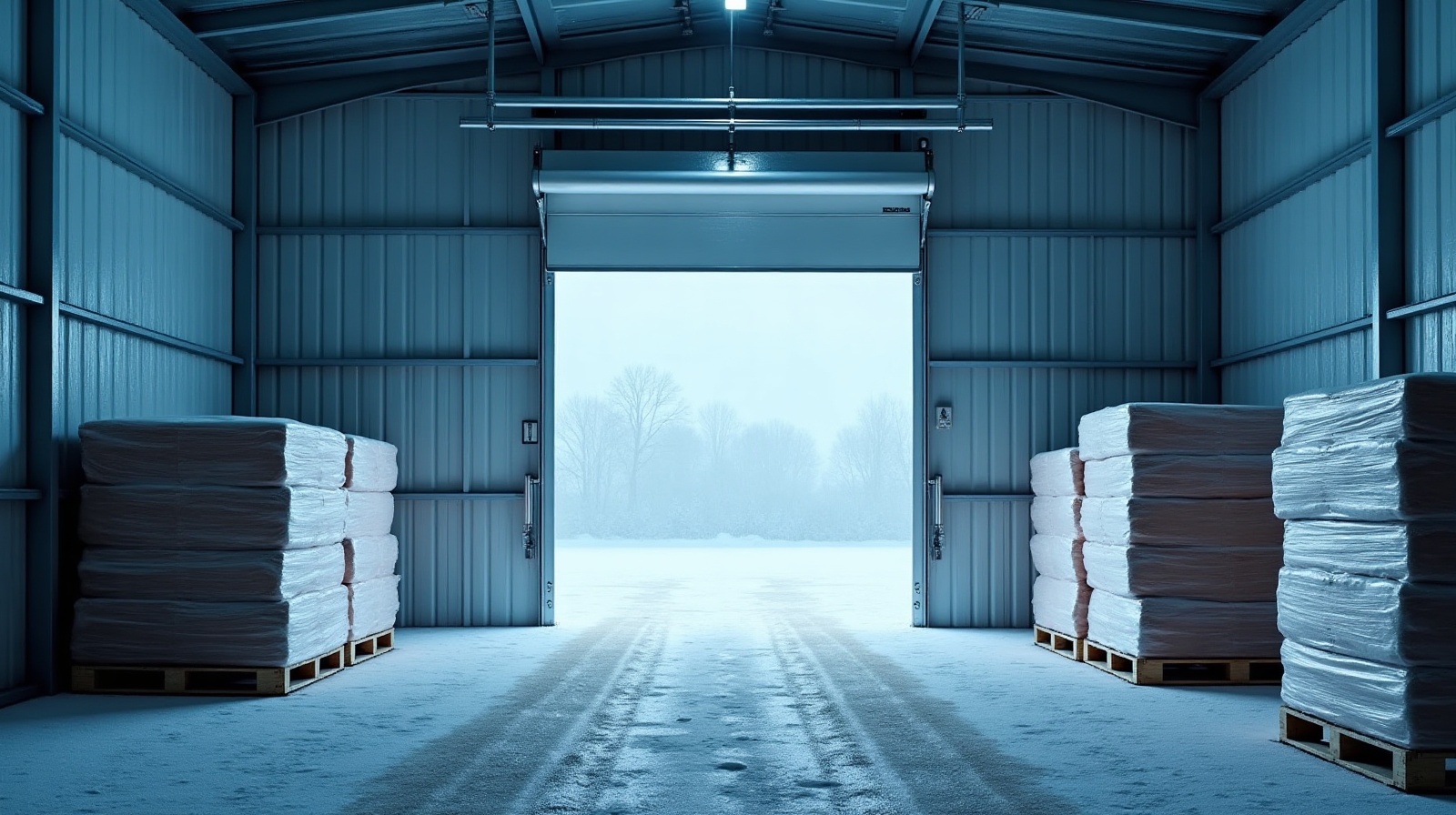
In a cold store, the door is the largest moving weak point in the building envelope. Walls and ceilings are closed with insulated panels, but every passage opens a direct connection between cold and warm air. Because cold air is heavier, it flows out through the lower part of the opening while warm, humid air flows in at the top. A high-speed door in a cold store shortens this time window to a few seconds and is therefore the most effective means of climate separation in day-to-day operation.
The cold chain consists of zones with different requirements. Chill rooms for fresh produce typically operate between 0 and +8 °C, freezer rooms typically between −18 and −28 °C, and colder in special cases. In between, there are often chilled ante-rooms, picking and loading areas. Each zone transition needs its own door concept: between the warehouse and a chill room, a well-insulated high-speed door is often sufficient; at the transition to the freezer area, a heated version is indispensable.
The real problem is moisture. When warm air meets sub-zero temperatures, the water it contains condenses and freezes: as ice on the floor in front of the door, as frost on walls and on the evaporator of the refrigeration system, and as ice in the door guides. Added to this is fog in the door area, which impairs forklift drivers’ visibility. Short open times, heated components, a tight bottom edge and a well-planned airlock are the most effective countermeasures.
This page looks at the cold storage door from an operational perspective: zones, processes, airlocks, energy and hygiene. How a freezer door is constructed technically, with heated guides, heated bottom edge and insulated curtain, is described on the product page Freezer door. For chill rooms with moderate temperature differences, the insulated high-speed door is also worth considering.
Requirements in this application
- Minimal ingress of air and moisture with every passage
- Ice-free operation at permanent sub-zero temperatures
- Curtain insulation matched to the temperature difference
- Unbroken cold chain without temperature peaks at zone boundaries
- Fast, touch-free passage for forklifts and order pickers
- Cleanable, corrosion-resistant surfaces in food environments
- High availability, because a failed door leaves the cold zone open
Typical challenges at the door opening
In chill and freezer stores, doors rarely fail because of the cold itself, but because of ice and moisture. A bottom edge that freezes to the floor, a curtain that has become stiff or ice in the guides will block the door; ice humps build up in front of the opening, and forklifts slip on them. Frost and fog also affect sensors and visibility. If the door fails, the cold zone may in the worst case stand open until a technician arrives, with a temperature rise in the room and a risk to the goods.
Operations also put the door under pressure. At peak times, forklifts and order pickers shuttle between ante-room and freezer room every minute. Slow, manually operated cold room doors are then left open, while strip curtains become scratched, ice up and leave a permanent gap. Every unnecessary second of open time increases the refrigeration load, makes the evaporator ice up faster and forces more frequent defrosting. Where a PVC strip curtain still makes sense and where a high-speed door is the better choice is explained on the product page.
The right solution
The design depends on the zone. As a cold room door for chill rooms above zero, a PVC high-speed door with an insulated or double-walled curtain is often sufficient; heating is usually not required there. For freezer areas with permanent sub-zero temperatures, a freezer door is the right choice: heated guides and a heated bottom edge prevent freezing, the insulated curtain reduces heat transfer, and a frequency inverter keeps the open time short.
With large temperature differences and high cycle rates, an airlock or pre-cooled ante-room is the most effective addition. Two doors are interlocked so that there is never a continuous connection between warm and cold. The chilled ante-room captures part of the moisture before it reaches the freezer room; additional dehumidification of the ante-room can reduce ice formation further. How long the airlock needs to be depends on the longest vehicle including its load, as explained under planning below.
In operation, combining the high-speed door with an insulated cold room door has proven itself: the cold room door is closed outside operating hours, while the high-speed door handles daytime traffic. Activation should be targeted: a radar motion detector with direction detection or an induction loop opens only when really needed, and the hold-open time is set as short as possible. Sensors and light curtain must be suitable for the temperature range. You can put together the right version in the configurator for freezer doors.
| Requirement | Solution at the door | Benefit |
|---|---|---|
| Keeping the cold in the room | Insulated, double-walled curtain with tight guides | Less heat transfer and air exchange |
| No icing in sub-zero areas | Heated guides and heated bottom edge | Door stays operational, no failures due to ice |
| Low moisture ingress | Airlock or ante-room with two interlocked doors | Less frost on the evaporator, less frequent defrosting |
| Short open time | Frequency inverter and activation with direction detection | Door opens only when needed and closes immediately |
| Safety despite fog | Light curtain, vision panels and good lighting in the door area | People and vehicles are detected |
| Hygiene in food areas | Stainless steel frame and smooth curtain surfaces | Easy to clean, corrosion-resistant |
| Power failure or fault | Emergency opening and fault signal to the control system | Cold zone remains accessible and monitored |
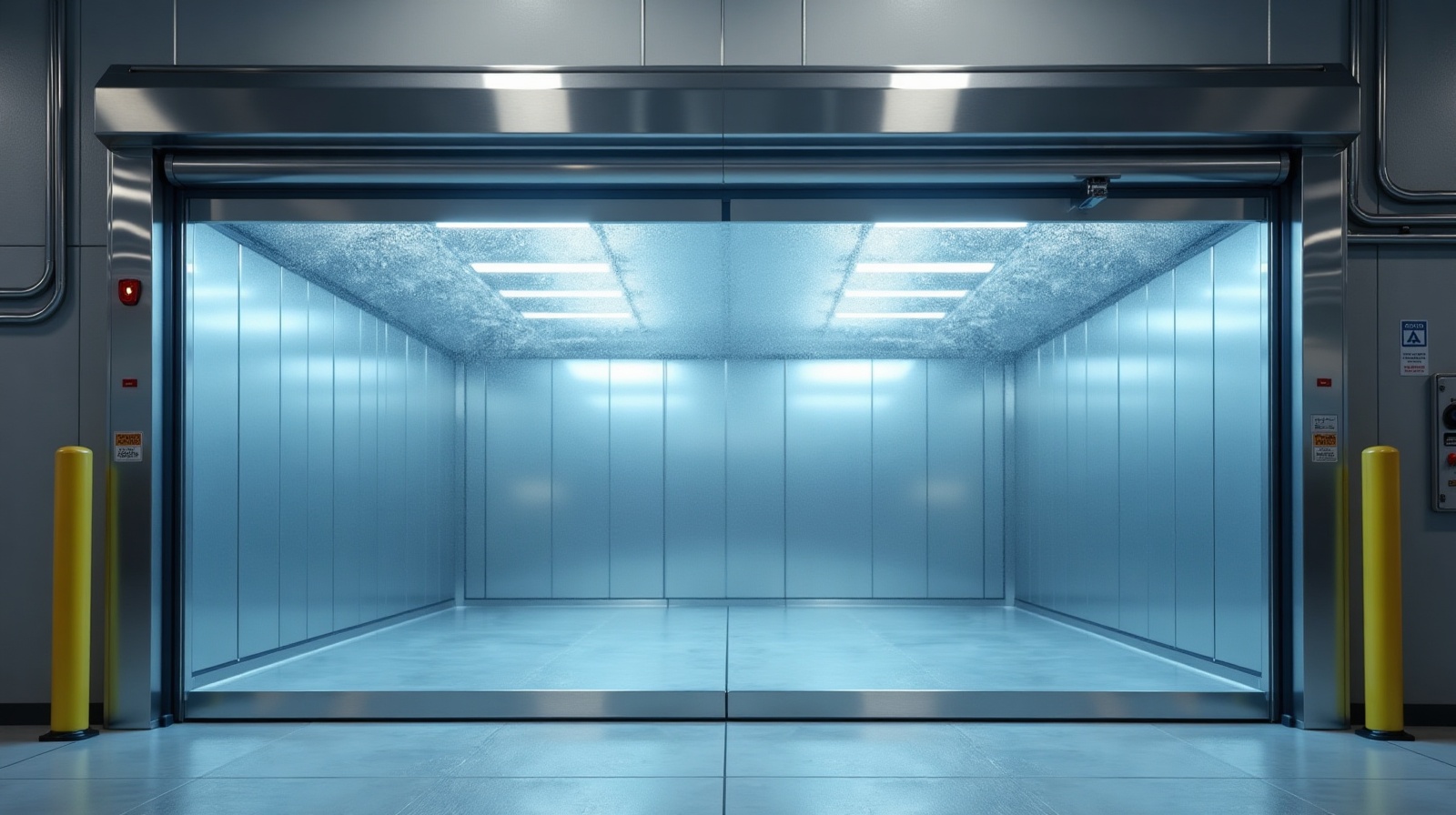
Configure a high-speed door for cold storage
Configure nowBenefits for your operation
- Stable room temperature and a secure cold chain
- Lower refrigeration load thanks to less air and moisture ingress
- Less ice on the floor and less frost on the evaporator
- Less frequent defrosting and more even operation of the refrigeration system
- Greater safety with less fog and fewer slippery surfaces in the door area
- Smooth forklift traffic without manual opening
- Hygienic separation of temperature and hygiene zones
Planning and installation
In cold store engineering, the door is part of an overall system of insulation, refrigeration plant and traffic routing. The basis is a zoning plan with temperature and humidity on both sides of each door. It shows where an insulated door is sufficient, where heating is needed and where an airlock makes sense. An airlock or ante-room must be provided for early in the floor plan: the space between the doors must fully accommodate the longest vehicle including its load, otherwise it becomes a bottleneck.
For installation in cold store panels, note that the panels do not normally carry the door themselves, so a mounting frame or steel structure that avoids thermal bridges is provided. Drive and heating require power, and the control unit is best placed on the warm side. The floor in the door area must be level so that the bottom edge seals tightly; falls and previous ice formation should be recorded in advance. The door is delivered direct from the factory and installed by your installer, who also connects the heating; what is included in the delivery is described under Delivery and installation.
In existing buildings, the high-speed door is often placed in front of an existing sliding cold room door, which is then retained as a night closure. In many cases, installation is possible without shutting down the refrigeration, but it should be scheduled for a period of low traffic. Coordinate the planning with your refrigeration contractor, for example regarding the position of the unit coolers, whose airflow should not be directed straight at the door opening. Typical opening sizes are listed on the page High-speed door sizes.
Regulations and standards
Cold storage doors are subject to the same basic rules as all power-operated doors: the product standard EN 13241 with CE marking and declaration of performance, EN 12453 for safety in use and EN 12635 for installation and use. Inspection and maintenance follow the manufacturer’s instructions and the national workplace regulations in the country of installation. The performance characteristics that can be declared under EN 13241 include thermal transmittance and air permeability; for insulated doors, ask for the U-value. For walk-in chill and freezer rooms, the operator’s risk assessment must also ensure that anyone trapped inside can leave the room or call for help at any time.
In the food sector, Regulation (EC) No 852/2004 requires procedures based on HACCP principles. The door should therefore have smooth, cleanable surfaces and corrosion-resistant components, such as a frame in stainless steel 304. Under the EU rules on quick-frozen foodstuffs (Directive 89/108/EEC), a temperature of −18 °C or colder applies, with narrowly limited tolerances, for example during transport. For the temperature-controlled storage of medicinal products, the EU guidelines on Good Distribution Practice (GDP) also apply; requirements in pharmaceutical areas are covered on the page High-speed doors for pharma and cleanrooms.
Cost-effectiveness
In a cold store, cold is produced with electricity, and in freezer areas the effort per unit of heat removed is particularly high. Open doors are among the largest uncontrolled items in the refrigeration load. Incoming air brings heat and moisture; the moisture puts a double burden on the system, because it is first bound as frost on the evaporator and then has to be removed again by defrosting. An example calculation for open time: with 300 passages a day and 15 seconds of open time per passage, the cold zone is open for 75 minutes a day; at 5 seconds, it is 25 minutes.
Added to this are the costs of failure. An iced-up door that no longer closes lets the cold escape unhindered and puts goods and temperature records at risk. The heating output of guides and bottom edge is small compared with the refrigeration capacity of the room and prevents exactly this situation. The factors that determine the investment and how it pays off over the service life are shown on the page High-speed door cost.
Recommended equipment
Typical sizes in this application: 2,500 × 3,000 mm to 4,000 × 4,500 mm. All common sizes are listed under High-speed door sizes.
Checklist for your enquiry
- Temperature and humidity on both sides of each door, for example warehouse, ante-room and freezer room
- Clear width and height as well as vehicle and pallet heights
- Cycle rate in the peak hour, operating hours and whether a night closure is needed
- Airlock or ante-room: existing, planned or not possible, with the length of the space between the doors
- Wall construction: cold store panels, masonry or steel structure, existing cold room door
- Floor in the door area: evenness, fall, previous ice formation
- Hygiene: food or pharma, HACCP requirements, cleaning agents, preferred materials
- Electrics and control: power supply for drive and heating, activation, interfaces and emergency opening
Suitable door types
Frequently asked questions
Which door is suitable for a cold store?
For chill rooms, a fast door with an insulated or double-walled curtain is usually the right solution. Freezer areas need a freezer door with heated guides and heated bottom edge. With large temperature differences and high cycle rates, an airlock of two doors completes the concept.
What is the difference between a cold storage door and a freezer door?
Cold storage door is the generic term for any door at a cold zone, from the chill room to the freezer store. A freezer door is the type designed for permanent sub-zero temperatures: insulated and heated at the points at risk of icing. In chill areas above zero, this heating is usually not required.
Why does a freezer store door ice up?
Because warm, humid air meets sub-zero temperatures when the door opens. The moisture condenses and freezes in the guides, at the bottom edge and on the floor in front of the door. Short open times, heated guides, a tight bottom edge and, if necessary, an ante-room that captures part of the moisture help to prevent this.
Do I need an airlock in front of the freezer room?
Not always, but often. An airlock is particularly worthwhile with a large temperature difference, a humid ante-room and many passages, for example at the transition from an unchilled warehouse to a freezer room. It requires enough space between the two doors for the longest vehicle including its load.
How much energy does a cold store lose through the door?
That depends on door area, temperature difference, humidity and above all on open time; a flat figure would not be credible. What is certain is that air exchange increases with every second of open time, and open doors are among the largest uncontrolled items in the refrigeration load. A fast, tightly closing door is therefore the most effective lever.
Is a strip curtain enough for a cold room?
For rarely used passages or as a supplement, a PVC strip curtain can be sufficient. However, it always leaves a gap, becomes scratched over time and can ice up in freezer areas. With regular forklift traffic, a high-speed door separates the zones much more effectively.
What temperature does a freezer store operate at?
Freezer rooms typically operate between −18 and −28 °C, and colder in special cases. For quick-frozen food, EU rules require a temperature of −18 °C or colder. Chill rooms for fresh produce are typically between 0 and +8 °C.
Can a freezer door be retrofitted?
In most cases, yes. The door is placed in front of the existing opening, often in front of an existing cold room door that remains as a night closure. Important points are a load-bearing mounting frame in the panel area, power for drive and heating and a level floor. Installation is carried out by your installer; you can put together the right version in the configurator.
Configure your high-speed door and request a quote
Choose size, curtain, drive and accessories in a few steps. You receive a non-binding quotation.