Application
High-speed doors for car parks
A high speed car park door is a power-operated entrance door – usually a quiet spiral or slatted door – that opens far faster than a conventional roller shutter. It cuts waiting times at the entrance, keeps unauthorised users out and spares the neighbours noise.
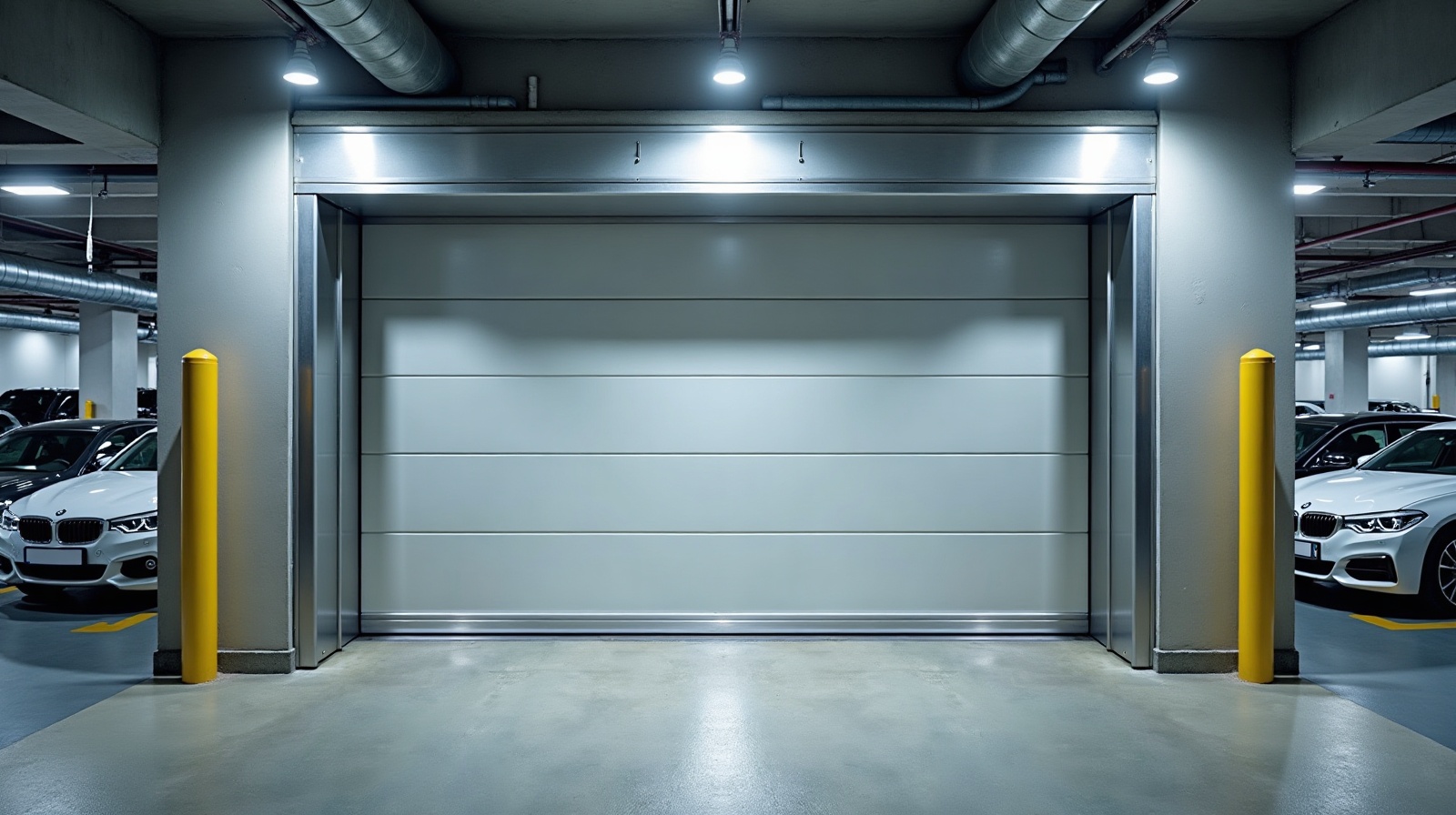
The door to an underground or multi-storey car park is a bottleneck that has to meet two demands: authorised users should get in without waiting, and everyone else should stay out. At the same time, the entrance is often directly below flats or next to offices, where every noisy door is a nuisance. High-speed doors for car parks therefore combine high opening speeds with quiet, low-wear operation.
If you are looking for an underground car park door, it pays to know the difference between the door types. A conventional roller shutter opens at less than 0.5 m/s; its curtain winds onto a barrel layer by layer, which is audible with frequent use and causes wear. Depending on type and size, a high-speed door reaches around 1.5 to 3 m/s. With an entrance height of 2.2 m, the roller shutter needs more than 4 seconds to open, while the high-speed door takes roughly 1 to 1.5 seconds in theory. How high-speed doors are built and how they work is explained on the page what is a high-speed door.
Two door types are typical for car parks: the spiral door, whose aluminium slats run without contact in a spiral guide, and the high-speed roller shutter with a slatted curtain, which is robust and economical. Flexible PVC curtains are more common at commercial entrances where break-in protection is not a requirement.
Whether a high-speed door or a conventional garage door is the right choice depends mainly on how the entrance is used. In residential developments, quiet running, simple operation by hand transmitter and low maintenance costs matter most; in a small car park with only a few movements a day, a conventional door is often enough. In office, hotel or public car parks, throughput at peak times, integration with number plate recognition or the ticketing system and high availability take priority. That is where a high-speed door shows its full advantages.
Requirements in this application
- Short opening time, so that no queue backs up into the street at peak times
- Quiet running without impact noise, especially below flats and at night
- Access control by radio, keypad, transponder, number plate recognition or ticket
- Protection against break-ins and against unauthorised vehicles following through
- Air permeability that matches the ventilation design of the car park
- Resistance to rain, frost and de-icing salt on the ramp
- Emergency opening during a power failure, so that all users can drive out
Typical challenges at the door opening
Most problems at car park entrances come down to noise and cycle frequency. A rattling roller shutter transmits structure-borne noise into the slab and can be clearly heard in the flats above – early in the morning and late in the evening a common cause of complaints. Contact-free spiral guides, soft start and stop and decoupled fixings address exactly this point. In office and company car parks, many vehicles arrive within a few minutes at the start of the working day. A slow door then causes queues and is often switched to permanently open, which defeats access control.
Environment and security add to this. Rainwater, snow and de-icing salt reach the bottom seal and guides via the ramp, and frost can freeze seals in place. Vehicles that follow closely behind an authorised user bypass access control, and overheight vehicles or careless manoeuvring damage the door curtain. Depending on the ventilation design, underground car parks also need air exchange through the closed door. A tightly sealing door can be the wrong choice here.
The right solution
For underground car parks below residential buildings, the spiral door is usually the first choice. Its aluminium slats run without contact in the spiral guide, and a frequency inverter starts the door gently and slows it down before it reaches the end position. This eliminates the clatter of slats lying on top of one another and the hard impact on the floor. The slats offer more mechanical resistance than a flexible curtain and, depending on the system, can be supplied with vision panels or ventilation openings.
Where the budget is tighter or use is moderate, a high-speed roller shutter with a slatted curtain is a robust compromise: much faster than a conventional roller shutter, slightly louder and subject to more wear than a spiral door. Design details and typical applications are on the high-speed roller shutter page. For car parks that are naturally ventilated through the door, perforated slats or ventilation openings let air through while still preventing access. The free ventilation area required follows from the car park's ventilation design.
Access control is matched to the user group. Residents and permanent tenants open the door by hand transmitter, keypad or transponder; commercial car parks use number plate recognition or a ticketing system with a barrier that triggers the door via a release signal. The principle of opening only on release is described in more detail for airports and secure areas. For exit, an induction loop opens the door automatically, and on single-lane ramps traffic lights control oncoming traffic. The door closes immediately after the vehicle has passed, so that nobody can follow through unnoticed.
| Requirement | Solution at the door | Benefit |
|---|---|---|
| Quiet running below flats | Spiral door, frequency inverter, fixings decoupled from structure-borne noise | Fewer complaints, even at night |
| Peak times without queues | Typically 1.5 to 3 m/s depending on type, exit via induction loop | Smooth entry and exit |
| Access control | Radio, keypad, transponder, number plate recognition or ticketing system | Only authorised vehicles enter |
| Break-in protection | Aluminium slats, immediate closing after each passage | Protection for vehicles and building |
| Car park ventilation | Perforated slats or ventilation openings | Air exchange with the door closed |
| Single-lane ramp | Traffic light control with loops on both sides | No oncoming traffic on the ramp |
| Power failure | Emergency opening by hand crank, emergency chain or backup battery | Vehicles can still drive out |
Configure a high-speed door for car parks
Configure nowBenefits for your operation
- Shorter waiting times at the entrance, even at peak times
- Quiet operation that hardly disturbs residents and neighbours
- Effective access control, because the door no longer has to stand open
- Less wear and fewer repairs thanks to the contact-free spiral guide
- Rain, snow and leaves kept out of the car park
- Integration with existing access and parking systems
- High-quality appearance with aluminium slats and optional glazing
Planning and installation
Planning a high-speed door for an underground or multi-storey car park starts with the geometry of the entrance. Measure the clear width and height, the headroom up to the lowest obstruction such as a downstand beam, pipework or ventilation duct, and the side room to the left and right. The space the spiral or coil needs above the opening differs from system to system; where ceiling height is tight, this is an early check. Typical opening sizes and the installation space they require are covered on the sizes page. A height restrictor in front of the entrance protects the door curtain from overheight vehicles.
Ramp and drainage affect installation. If the door sits at the foot of a ramp, a drainage channel belongs in front of the door line, so that no water stands at the bottom seal and freezes in winter. Induction loops are cut into the road surface and planned with clearance from the channel and reinforcement. For open entrances, choose the wind resistance class to EN 12424 to suit the exposure of the façade; corrosion-protected profiles help against frost and de-icing salt. The criteria for external openings are summarised on the outdoor high-speed door page.
In residential developments, the owners' association usually decides on replacement; noise levels, movements per day and the repair history of the old door provide a solid basis for that decision. Replacing an existing car park door is generally straightforward if headroom and side room are sufficient. The door is delivered direct from the factory and installed by your installer – your own facilities team or a local door company; what is supplied and what the installer needs is described under delivery and installation. Clarify integration with an existing access or parking system in advance via the available interfaces.
Regulations and standards
Doors at car park entrances are covered by the product standard EN 13241, with CE marking and declaration of performance, and by EN 12453 on the safety in use of power-operated doors: safety edges, photocells or light curtains and limited closing forces protect people and vehicles. Installation and use are addressed in EN 12635. Inspection and maintenance follow the manufacturer's instructions and the national workplace regulations in the country of installation and are carried out by your installer or maintenance provider. Regular inspection is also advisable in residential car parks, because the operator is responsible for the safe condition of the door.
Ventilation, fire protection and escape routes are governed by the building regulations for car parks that apply in the country of installation and by the building's fire safety strategy. These determine whether the door must provide a free ventilation area or open or close automatically in a fire, and whether pedestrians need a separate exit. If tested burglar resistance is required, a resistance class to EN 1627 must be explicitly requested, because many high-speed doors are not classified for this.
Cost-effectiveness
In a car park, a high-speed door pays off less through heating energy than through availability and service life. A conventional roller shutter that runs several hundred times a day wears out its curtain, bearings and drive much faster than a spiral door with a contact-free guide, and every fault often blocks the only entrance. Shorter waiting times at peak hours and, in heated or tempered car parks, lower heat losses come on top.
The investment depends mainly on door type, size, slat design, glazing and integration with the access system. Over the service life, maintenance and repairs often weigh more heavily than the purchase price. The factors that drive the price are explained on the high-speed door cost page; you can request a quote for your entrance via the spiral door configurator.
Recommended equipment
Typical sizes in this application: approx. 3,000 × 2,200 mm (single lane) to 5,500 × 3,000 mm (two lanes). All common sizes are listed under High-speed door sizes.
Checklist for your enquiry
- Type of property: residential development, office or company car park, hotel or public car park.
- Dimensions: clear width and height, headroom and side room up to the nearest obstruction.
- Use: number of parking spaces, movements per day and peaks at rush hour.
- Access control: radio, keypad, transponder, number plate recognition or existing ticketing system.
- Location: ramp, open or covered entrance, flats directly above the entrance.
- Ventilation and fire protection: requirements from the car park's ventilation and fire safety design.
- Safety: pedestrians in the entrance, traffic light control, emergency opening during a power failure.
- Existing situation: old door, known faults, existing electrical and access control equipment.
Suitable door types
Frequently asked questions
Which door is best for an underground car park?
For underground car parks with many movements or flats above the entrance, a spiral door is usually the best choice: fast, quiet and low-wear. With moderate use, a high-speed roller shutter with a slatted curtain is an economical alternative. In small car parks with only a few movements a day, a conventional garage door is often sufficient.
What is the difference between a roller shutter and a high-speed door in an underground car park?
A conventional roller shutter opens at less than 0.5 m/s, and its curtain winds up layer by layer. Depending on type, a high-speed door reaches around 1.5 to 3 m/s, and with a spiral door the slats run without contact. The high-speed door is therefore faster, usually quieter and designed for high cycle rates; more on the spiral door page.
How loud is an underground car park door?
That depends on door type, drive and fixings. Spiral doors with a frequency inverter run particularly quietly, because the slats do not knock against each other and the door moves gently into its end position. Fixings decoupled from structure-borne noise prevent sound from travelling through the slab into the flats.
How do you open a car park door without getting out of the car?
On entry by hand transmitter, transponder, number plate recognition or a ticketing system, and on exit automatically via an induction loop. A keypad adds an option for users without a transmitter. These systems can be combined and connected to an existing access control system.
Does a high-speed door protect a car park against break-ins?
A spiral door with aluminium slats offers much more resistance than a flexible curtain and closes immediately after each passage, which makes it harder for unauthorised vehicles to follow through. However, this does not automatically mean tested burglar resistance with a resistance class – that has to be requested explicitly.
Does an underground car park door need ventilation openings?
That depends on the car park's ventilation design. If the car park is naturally ventilated through the door, perforated slats or ventilation openings with a defined free area are required. The deciding factors are the building regulations for car parks in the country of installation and the design of the building.
What happens to a car park door during a power failure?
The door stops in its current position. It can still be opened by an emergency opening via hand crank, emergency chain or backup battery. In car parks with many users, a backup battery is convenient, because the door continues to respond at the push of a button.
How fast does a high-speed door open in a car park?
Depending on type and size, at around 1.5 to 3 m/s. A 2.2 m high entrance is therefore clear in roughly 1 to 1.5 seconds in theory, whereas a conventional roller shutter at less than 0.5 m/s needs more than 4 seconds for the same height. At peak times, this prevents queues in front of the entrance.
Configure your high-speed door and request a quote
Choose size, curtain, drive and accessories in a few steps. You receive a non-binding quotation.