Application
High-speed doors for the automotive industry
In the automotive industry, a high-speed door is part of the production cycle: it opens in seconds at transitions between body shop, paint shop, assembly and logistics, separates dust and climate zones and keeps material flowing at very high cycle rates.

A car plant is a chain of zones with very different requirements: press shop, body shop, paint shop, final assembly and logistics. At every transition, the door determines whether material flow keeps pace with the cycle and whether dust, noise and conditioned air stay where they belong. Automotive high-speed doors open at typically 1.5 to 3 m/s and close again immediately after each passage. How these doors are built and which types exist is explained on the high-speed doors overview page.
Each zone places its own demands on the door. In the body shop, robot cells work at high cycle rates, and welding fumes and noise should not reach neighbouring areas. The paint shop needs low-dust areas under slight overpressure with controlled temperature and humidity. In final assembly, tugger trains, automated guided vehicles (AGVs) and people cross paths, and in logistics, goods receipt, sequencing and line-side delivery meet.
Automotive suppliers have the same requirements, often in less space: parts are produced and picked in sequence and delivered to the plant in time with call-offs. External doors at the loading bay must withstand wind and weather, while internal transitions above all need to be fast and robust. For external openings, the criteria for loading bays and access points apply; for pure warehousing processes, those for logistics and warehousing.
A smaller but frequent application is vehicle workshops and car dealerships. At the workshop entrance and vehicle reception, the door opens many times a day while vehicles are being worked on inside. A high-speed door keeps the workshop warm and free of draughts; a glazed spiral door also suits the look of a dealership.
Requirements in this application
- Very high cycle rates in multi-shift operation without waiting times
- Tight, low-dust separation in front of the paint shop and finish areas
- Maintaining overpressure, temperature and humidity between zones
- Safe passage for AGVs, tugger trains, forklifts and people
- Interface with the plant and conveyor control system
- Crash protection at heavily used logistics transitions
- Predictable maintenance in non-production time windows
Typical challenges at the door opening
In a car plant, the door is part of the cycle. AGVs and tugger trains run to fixed schedules; if a door opens too late or closes on a long tugger train with several trailers, the vehicle stops and the cycle breaks. Add to this mixed traffic with forklifts and people, impacts at narrow transitions and doors that remain open after a fault, which cancels zone separation. How the door interacts with conveyors and control systems therefore has to be defined before the door is ordered, not during commissioning.
In the paint shop, the requirements are different. Paint areas are usually kept under slight overpressure so that dust is not drawn in; every open door lets conditioned air escape and disturbs pressure and airflow conditions. Dust particles and fibres can damage the finish, and where solvent vapours occur, hazardous (Ex) zones are designated. In the body shop, sparks and welding fumes put strain on the curtain; in the press shop, it is the noise that should not spread from the hall into quieter areas.
The right solution
For transitions in the body shop, assembly and logistics, lightweight clear curtain doors and PVC high-speed doors with a frequency inverter are suitable. They achieve high cycle rates, start and stop gently and therefore spare curtain and mechanics. A zip system acting as crash protection lets the curtain come out of the guide in a controlled way on impact and re-inserts it on the next cycle, so the transition does not fail.
In front of the paint shop and finish areas, tightness is what counts: a dense curtain with perimeter seals, smooth, easy-to-clean surfaces without pockets and a short opening time. Where overpressure and climate must remain particularly stable, two mutually interlocked doors form an airlock that never opens on both sides at once. If the door is located in a hazardous zone, the drive, control unit and sensors must be of an explosion-protected design suited to the zone.
For AGVs and conveyor systems, the door is generally requested directly by the plant control system: the vehicle or conveyor section registers via volt-free contacts or a fieldbus interface, the door reports back via its limit switch as soon as it is fully open, and only then does the vehicle drive through. A light curtain monitors the entire passage plane so that the door does not close on a trailer; traffic light control manages oncoming traffic.
| Requirement | Solution at the door | Benefit |
|---|---|---|
| Very high cycle rate | Lightweight curtain, frequency inverter, typically 1.5 to 3 m/s | No waiting time at the transition |
| AGVs and tugger trains | Request via plant control, door-open feedback, light curtain | Passage without stopping, no closing on trailers |
| Dust and overpressure in the paint shop | Dense curtain with perimeter seals, airlock if required | Clean finish, stable pressure conditions |
| Impacts in mixed traffic | Zip crash protection with re-insertion | No downtime after minor contact |
| Ex zone due to solvent vapours | Drive, control unit and sensors in Ex design | Permitted operation in the designated zone |
| Air-conditioned assembly | Short opening time, insulated curtain where the temperature difference is large | Lower heating and cooling load |
| Workshop entrance at a dealership | Spiral door or insulated door, radio or induction loop | Warm workshop, entry without getting out |
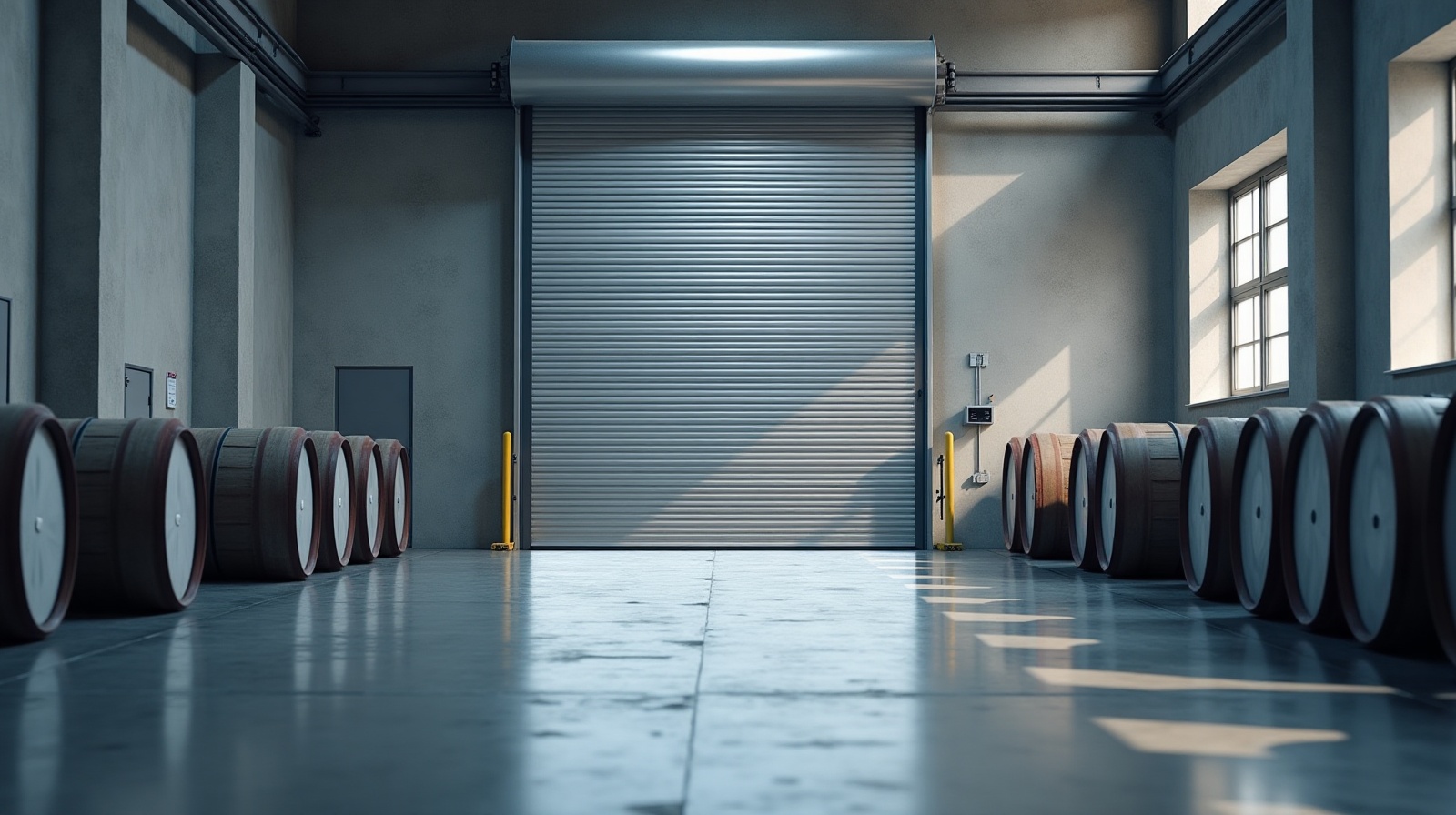
Configure a high-speed door for the automotive industry
Configure nowBenefits for your operation
- Material flow in step with the cycle, without waiting at hall transitions
- Clean separation of body shop, paint shop, assembly and logistics
- Stable pressure and climate conditions in the paint shop
- High availability thanks to crash protection and inverter-controlled drive
- Safe passages in mixed traffic with AGVs and people
- Lower heating and air-conditioning load in large halls
- Fewer draughts at workstations in plant and workshop
Planning and installation
Planning starts with a traffic and cycle analysis: passages per hour, vehicle types, the longest unit such as a tugger train with several trailers, and the approach speed of the AGVs. This determines when the door must be requested so that it is fully open before the vehicle reaches the opening. A 4 m high door at 2 m/s needs around 2 seconds to open; this time plus reaction time has to be built into the pre-trigger. The number of cycles also determines the design of drive and curtain, which is why the expected cycles per day belong in every enquiry.
In existing buildings, the space above the opening is often limited by conveyors, crane runways, ventilation ducts or sprinkler pipes. Door types with low headroom requirements or a side-mounted drive help here; guide values are on the sizes page. A high-speed door is not a fire-rated closure: if the transition lies in a fire wall, a separate fire door or fire shutter is also needed, and its closing area must remain clear. Installation is best scheduled in non-production time windows; the door is delivered direct from the factory and installed by your installer or your plant engineering team, as described under delivery and installation.
In vehicle workshops, a clear height of about 3.0 to 3.5 m is typically planned for cars and vans, and more for motorhomes and vans with bodies. Often the high-speed door replaces an existing sectional door or supplements it on the inside. It is activated by radio, pull switch or induction loop so that staff can drive in without getting out. When replacing a door during ongoing operation, plan dismantling of the old door, cabling and commissioning as one coordinated slot with your installer.
Regulations and standards
Like any power-operated door, a high-speed door in a car plant must comply with the product standard EN 13241 and the safety-in-use requirements of EN 12453, i.e. operate with safety edges and non-contact monitoring. Inspection and maintenance follow the manufacturer's instructions and the national workplace regulations in the country of installation and are carried out by your installer or maintenance provider. If the door becomes part of an integrated system with AGVs or conveyors, the interface belongs in the risk assessment of the overall system.
In potentially explosive areas of the paint shop, the operator defines the zones in the explosion protection document. The door must then be suitable as equipment for the relevant zone under the ATEX Directive 2014/34/EU, including all electrical components and sensors.
Cost-effectiveness
In a car plant, a high-speed door pays off mainly through availability and cycle time. A transition where AGVs or tugger trains wait a few seconds every time costs measurable production time over many passages per shift; a failed door at a sequencing transition can, in the worst case, interrupt line supply. Crash protection, an inverter-controlled drive and maintenance based on the cycle count keep this risk low.
Energy comes on top: paint shops and air-conditioned assembly halls move large volumes of conditioned air, and every unnecessary second of opening time increases the load on ventilation, heating and cooling. In vehicle workshops, the same effect applies to heating costs. How to weigh purchase, operation and savings against each other is shown on the high-speed door cost page; decision criteria for production and plant managers are collected on the page for operations managers.
Recommended equipment
Typical sizes in this application: 3,000 × 3,500 mm to 5,000 × 5,000 mm. All common sizes are listed under High-speed door sizes.
Checklist for your enquiry
- Zones: which areas the door separates and whether overpressure, low dust or explosion protection is required
- Traffic: AGVs, tugger trains, forklifts, trucks and people, passages per hour and shift pattern
- Largest unit: longest and tallest vehicle including load
- Interface: request and feedback via plant control, volt-free contacts or fieldbus
- Installation space: clear opening dimensions, headroom, side room and obstructions such as conveyors or sprinklers
- Fire protection: whether the opening lies in a fire wall with a fire-rated closure
- Climate: temperatures and airflow on both sides of the door
- Installation window: possible slots in the production plan; then put your door together in the configurator
Suitable door types
Frequently asked questions
Why does the automotive industry use high-speed doors?
Because production and logistics run in cycles, and every hall transition would otherwise become a bottleneck. High-speed doors open at typically 1.5 to 3 m/s, close immediately after each passage and separate dust, noise and climate zones. This maintains both material flow and zone separation.
Which high-speed door is suitable for a paint shop?
A tightly closing high-speed door with perimeter seals, a smooth, easy-to-clean curtain and a short opening time. Where pressure and climate must remain particularly stable, two interlocked doors form an airlock. In Ex zones, the door also needs an explosion-protected design.
How does a door keep dust out and overpressure in a paint shop?
The paint area is kept under slight overpressure so that air flows outwards and not inwards. A tight door limits air loss when closed, and the high opening speed limits it during each passage. Where requirements are high, an airlock ensures that both sides are never open at the same time.
How does a high-speed door open for automated guided vehicles?
The AGV registers via the plant control system or a radio signal in front of the door; the door opens and reports back via its limit switch as soon as it is fully open. Only then does the vehicle drive through. A light curtain keeps the door open until the entire unit has passed the opening.
Which door is suitable for the body shop?
In the body shop, cycle rate and robustness count, so lightweight PVC or clear curtain doors with frequency inverter and crash protection are usually used. They keep welding fumes and noise away from neighbouring areas. Where sparks cannot be ruled out, the curtain should be shielded by welding screens.
What happens if a forklift hits the door?
With a zip-system door, the curtain comes out of the guide in a controlled way instead of tearing, and re-inserts itself automatically on the next cycle. The transition usually remains available without a technician call-out. Suitable designs are described on the PVC high-speed door page.
Is a high-speed door worthwhile for a vehicle workshop?
Yes, if the entrance is opened many times a day and the workshop is heated. The door keeps heat in the hall and draughts away from workstations, and it opens by radio or induction loop without the driver getting out. With only a few openings a day, a well-insulated sectional door can be the more economical solution.
Which high-speed doors do automotive suppliers need?
Suppliers need fast, robust indoor high-speed doors at hall transitions and wind-resistant external doors at the loading bay. Because they deliver to the plant in sequence, door availability is just as critical as in the plant itself. Crash protection and predictable maintenance are therefore advisable.
Configure your high-speed door and request a quote
Choose size, curtain, drive and accessories in a few steps. You receive a non-binding quotation.