Application
High-speed doors for loading bays and access points
A loading bay or access door in high speed design forms the boundary between building and weather at docks, access roads, vehicle halls and wash bays: it must withstand wind and weather, yet open and close in seconds so that heat, spray and draughts do not escape.
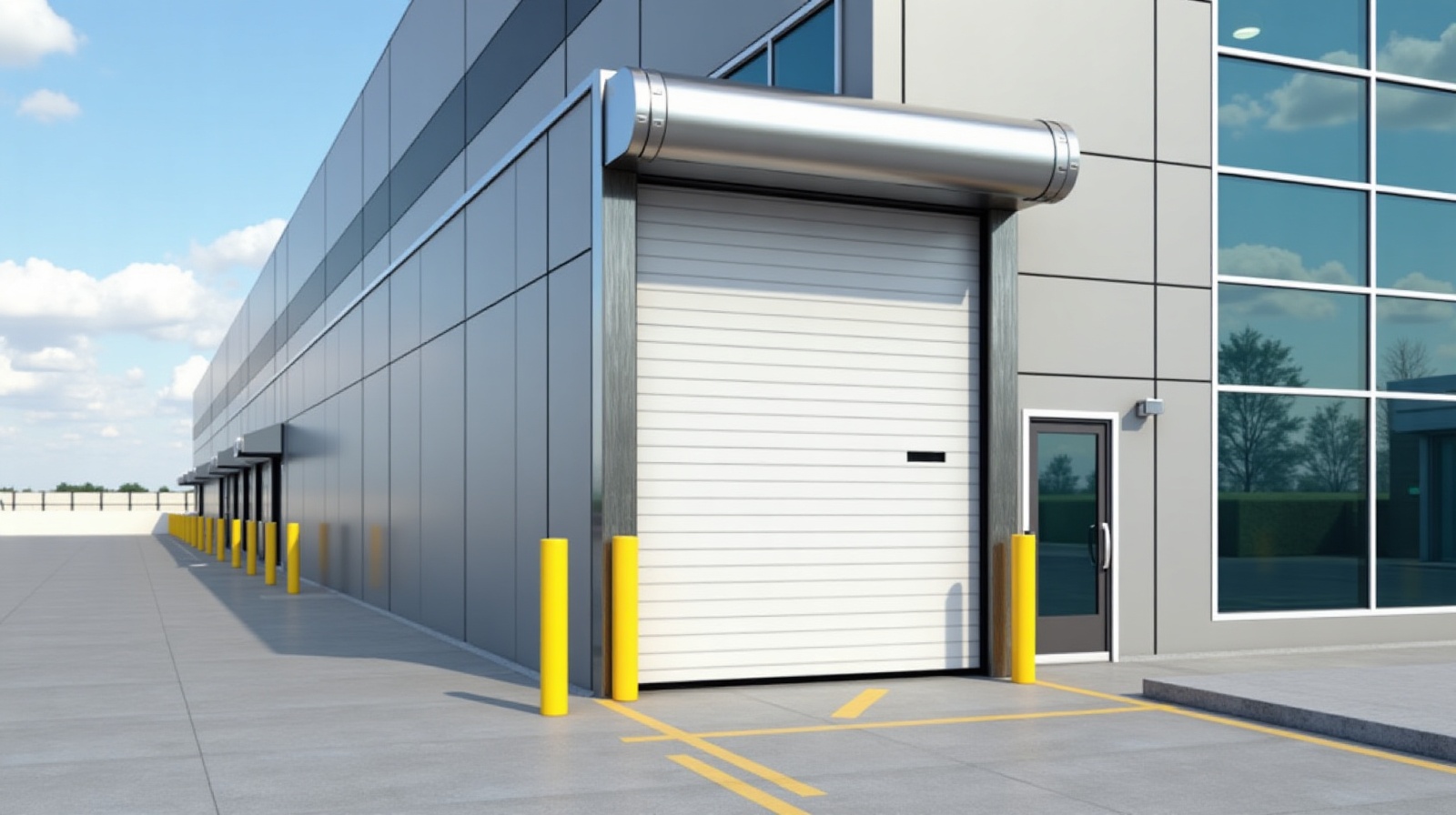
Outdoors, a high-speed door sits wherever vehicles pass through the building envelope: at loading bays and docks, at access roads and drive-through openings, at vehicle halls and wash bays, and at halls used by municipal depots, works fire brigades and ambulance stations. At all these points, the door separates the heated hall from the weather. It has to withstand wind, rain, frost and UV radiation and still open so quickly that no vehicle has to wait. The door types designed for this are shown on the outdoor high-speed door page.
The main reason for a high-speed door in the building envelope is the short time the opening stands open. At typically 1.5 to 2.5 m/s, a wind-resistant external door opens many times faster than a sectional door at around 0.2 m/s and closes automatically right after each passage. At the building boundary, where the temperature difference between inside and outside is greatest, this limits heat loss, draughts and driving rain. How high-speed doors compare with roller shutters and sectional doors is summarised on the high-speed doors overview page.
Doors for wash bays and vehicle wash facilities are a special case of outdoor use. In truck washes, rollover car washes, tunnel washes and vehicle care halls, splash water, spray mist, cleaning chemicals and, in winter, de-icing salt act on the door constantly. A wash bay door therefore needs corrosion-resistant frames and guides, a chemical-resistant curtain, a control unit protected against moisture and an activation system that responds to vehicles rather than to water jets or foam. Materials and operation are described on the page high-speed doors for vehicle wash facilities.
In vehicle halls at municipal depots, works fire brigades and emergency services, availability comes first. The door must open immediately when a call-out comes in, even after a frosty night or during a power failure. This calls for activation via the alerting system, heated guides and an emergency opening. For very large or highly exposed openings, a slatted door is often the more robust choice, as described on the spiral door page.
Requirements in this application
- Wind resistance class to EN 12424 to suit location and door size
- Weather- and UV-resistant curtain, corrosion-protected frame
- Sufficient clear height and width for trucks, vans and forklifts
- Reliable winter operation without the curtain or bottom seal freezing
- Activation that reliably detects vehicles and ignores cross traffic
- Crash protection against impact during manoeuvring
- Emergency opening during a power failure and fast opening on alarm
Typical challenges at the door opening
At loading bays and access roads, wind is the biggest load. With the door closed, it presses on the entire curtain area; an underdesigned curtain bulges, flutters or is pushed out of its guide. Add to this impacts from manoeuvring trucks and forklifts, rain and snow that reach the hall floor while the door is open, and queues when a slow door holds up approaching vehicles. In practice, a sluggish door is often left open for the entire shift, with high heat loss and draughts at the workstations.
In wash bays and vehicle halls, moisture comes on top. Splash water, spray mist and cleaning agents attack unprotected steel, and de-icing salt brought in by vehicles accelerates corrosion in winter. Spray mist and foam can interfere with optical sensors, and water standing in front of the door freezes on the bottom seal in frost. Cold also stiffens the curtain and slows lubricants and drives, which is why heated guides, a cold-flexible curtain and a drainage channel in front of the door are the most effective countermeasures.
The right solution
For most external openings up to about 5 × 5 m, a wind-resistant outdoor high-speed door with a PVC curtain is the right solution. Integrated wind bars stiffen the curtain, deep guides and a zip system keep it in the track during gusts and automatically re-insert it after an impact. For many external doors in normal locations, wind resistance class 2 or 3 is considered practical; exposed, free-standing or tall façades need class 4 or 5.
For very large openings or high wind loads, a spiral door with aluminium slats is the more stable choice. In tempered halls, an insulated high-speed door or a double-membrane curtain improves the insulation of the closed surface. At loading points with frequent truck changes, combining the high-speed door with an insulated sectional door has proven effective: the sectional door serves as night and weather closure, the high-speed door closes the opening between loading operations in seconds, and a dock shelter seals the gap between truck body and façade during loading.
For wash bays and vehicle wash facilities, frames, guides and fixings in stainless steel grade 1.4301 (AISI 304) are recommended, or in a higher-alloyed stainless steel where salt or chloride exposure is high, together with a chemical-resistant curtain and a control unit protected against splash water. Outdoors, the door is usually activated by an induction loop that responds only to vehicles, by radar with direction detection, or directly by a signal from the wash system or the alerting system. Where entry and exit share the same opening, traffic lights control oncoming traffic.
| Requirement | Solution at the door | Benefit |
|---|---|---|
| Wind on an exposed façade | Wind resistance class to EN 12424, wind bars, zip guide | Curtain stays in the guide in gusts |
| Impact during manoeuvring | Crash protection with automatic re-insertion | No downtime after minor contact |
| Heated or tempered hall | Insulated curtain or double membrane, perimeter seals | Less heat loss with the door closed |
| Splash water, chemicals, de-icing salt | Stainless steel frame, control unit protected against splash water | No rust, no moisture damage to the electrics |
| Frost and snow | Heated guides, frost-resistant bottom seal | Door does not freeze and opens even after frosty nights |
| Truck and forklift traffic | Induction loop, radar with direction detection, traffic lights | Timely opening, no false triggering by cross traffic |
| Power failure or alarm | Emergency opening, activation via the alerting system | Passage remains possible at all times |
Configure a high-speed door for loading bays and access points
Configure nowBenefits for your operation
- Short opening times reduce heat loss and draughts at the building envelope
- No queues at loading bays, access roads and wash facilities
- Drier, safer hall floors behind the door
- Less impact damage and downtime thanks to crash protection
- Reliable operation in wind, rain and frost
- Longer service life thanks to corrosion-resistant components in wet areas
Planning and installation
The door size is determined by the tallest and widest vehicle. Under the EU rules for international road transport, trucks are generally limited to 4.00 m in height and 2.55 m in width, refrigerated vehicles to 2.60 m; some countries permit taller vehicles nationally. For truck access points, a clear passage height of typically 4.20 to 4.50 m and a width from around 3.50 m are therefore planned, and rather more at wash facilities because of mirrors and bodies. Dock doors at the loading bay are lower because of the dock height, often around 3,000 × 3,000 mm. Above the opening, the barrel needs headroom, and the guides need side room on each side; the values depend on door type and size.
An external door is installed either in front of the façade or inside behind the reveal. Internal installation protects barrel and drive from rain and direct wind; for installation in front of the façade, a weather hood over the barrel is needed. At floor level, the seal has to follow the gradient of the access road; in wash bays, a drainage channel belongs in front of the door so that no water stands at the bottom seal and freezes. Induction loops are milled into the surface, and power and control cables should be in place before installation. The door is delivered direct from the factory, complete with drive and control as configured, and installed by your installer; details are on the delivery and installation page.
The required wind resistance class is derived from the wind zone, terrain category, building height and exposure of the façade; your planner or installer determines it on the basis of the wind load rules that apply at the site. In existing buildings, a high-speed door can usually be fitted in an existing opening or added behind an existing sectional door without altering the façade. If you are an installer or dealer sourcing made-to-measure doors for your customers, see the page for installers and dealers.
Regulations and standards
Power-operated doors are covered by the product standard EN 13241, whose declaration of performance also includes the wind resistance class to EN 12424 and information on water tightness, air permeability and thermal transmittance. Safety in use, with safety edges and non-contact monitoring, is governed by EN 12453; installation and use are addressed in EN 12635. Inspection and maintenance follow the manufacturer's instructions and the national workplace regulations in the country of installation and are carried out by your installer or maintenance provider.
Next to doors used mainly by vehicles, workplace regulations generally call for a clearly visible pedestrian door, unless pedestrians can pass through the vehicle door safely. For fire stations, national planning rules may contain their own requirements, including door dimensions, which should be agreed with the client in advance. In every case, the building's fire safety strategy and the regulations that apply in the country of installation take precedence.
Cost-effectiveness
Economically, what counts at the building envelope is the time the opening stands open. A 4 m high sectional door at around 0.2 m/s needs about 20 seconds to open and just as long to close, a high-speed door at 2 m/s only a few seconds. With many passages a day, this adds up to much less air exchange and a lower heating load.
Throughput and availability come on top: the fast door prevents waiting times, crash protection avoids repair downtime, and corrosion-resistant components reduce follow-up costs in wet areas. What determines the price and how the investment pays off is explained on the high-speed door cost page; for a quote, put your door together in the outdoor door configurator.
Recommended equipment
Typical sizes in this application: 3,000 × 3,000 mm to 5,000 × 5,000 mm. All common sizes are listed under High-speed door sizes.
Checklist for your enquiry
- Door location: side of the building, prevailing wind direction, free-standing or sheltered façade
- Opening dimensions: clear width and height, and the tallest vehicle including bodies and mirrors
- Installation space: headroom, side room and installation in front of the façade or behind the reveal
- Climate: inside and outside temperatures, heated or tempered hall, insulation requirement
- Media at the door: splash water, cleaning chemicals, de-icing salt
- Traffic: vehicle types, passages per hour, oncoming traffic and pedestrians
- Activation and interfaces: induction loop, radar, radio, signal from the wash system or the alerting system
- Existing situation: existing sectional door, dock shelter or dock leveller; then put your door together in the outdoor door configurator
Suitable door types
Frequently asked questions
Which door is suitable for a wash bay?
A weather-resistant high-speed door with a corrosion-resistant stainless steel frame, a chemical-resistant curtain and a control unit protected against splash water. It closes in seconds after each entry and exit, keeping spray mist in the wash bay and the cold outside. Details are on the page high-speed doors for vehicle wash facilities.
Will a door rust in a vehicle wash?
Painted steel corrodes quickly in wash facilities, and over time de-icing salt and cleaning chemicals also attack galvanised surfaces. Doors for wash facilities therefore have frames, guides and screws in AISI 304 stainless steel, or in a higher-alloyed grade where chloride exposure is high. The curtain must be chemical-resistant so that it does not become brittle.
How does a wash bay door open automatically?
Usually via an induction loop in the floor that responds only to vehicles, or via a signal from the wash system controller, for example at the end of a wash programme. Radar is possible but should be set so that water jets, foam or brushes do not trigger an opening. Traffic lights at entry and exit control the sequence.
Which wind resistance class does a high-speed door at a loading bay need?
That depends on wind zone, building height, exposure of the façade and door size. For many external doors in normal locations, class 2 or 3 to EN 12424 is considered practical; exposed and large doors need class 4 or 5. One class in reserve prevents the curtain from being pushed out of its guide in a storm.
Can a high-speed door be combined with a sectional door?
Yes, this is common at loading bays and hall doors. The insulated sectional door serves as night and weather closure, while the high-speed door handles the frequent openings during the day. At the dock, a dock shelter completes the combination by sealing the gap between truck and façade during loading.
How high does a door for truck access need to be?
In international road transport, trucks are generally limited to 4.00 m in height. For an access road or drive-through, a clear height of typically 4.20 to 4.50 m and a width from about 3.50 m are therefore planned, more if manoeuvring space is tight. The deciding factor is always the tallest vehicle that actually passes through the opening.
Does a high-speed door freeze in winter?
A door designed for outdoor use works reliably in frost. Heated side guides, a cold-flexible curtain and a frost-resistant bottom seal prevent freezing. It is also important that no water stands in front of the door and that snow is cleared from the closing area.
Is a high-speed door sufficiently insulated as an external hall door?
A single-skin PVC curtain provides little insulation; it works mainly through the short opening time. For tempered halls there are insulated curtains and double membranes that significantly reduce heat transfer, although an insulated sectional door still achieves better insulation values. Which design fits is shown on the outdoor high-speed door page.
Configure your high-speed door and request a quote
Choose size, curtain, drive and accessories in a few steps. You receive a non-binding quotation.