Application
High-speed doors for airports and secure areas
A high-speed door in an airport or secure area is a power-operated door that opens only on release at baggage handling systems, cargo halls and controlled access points and closes again immediately. It supports the security concept but does not replace a burglar-resistant closure.
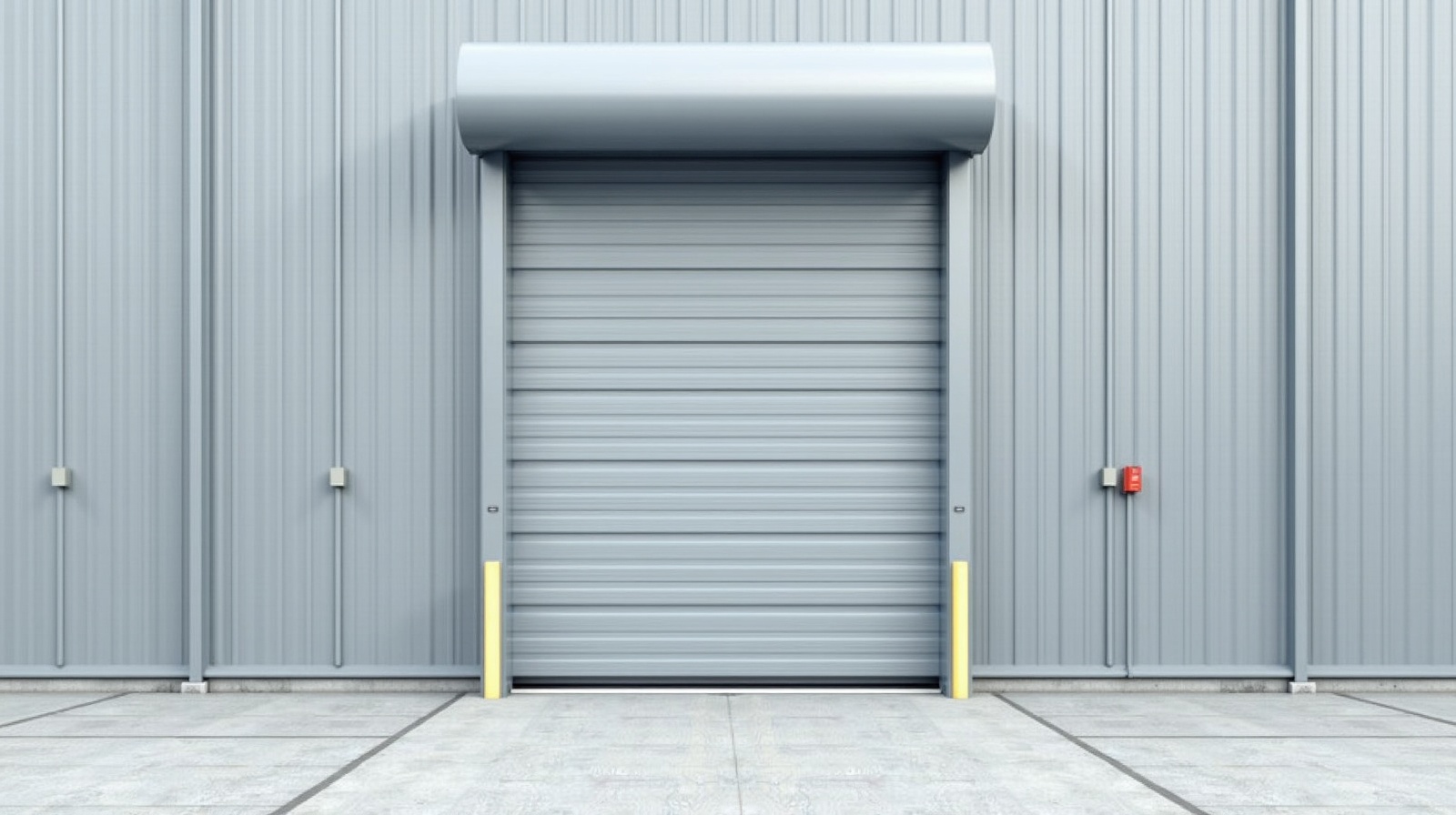
At airports and in other areas with restricted access, a door has two tasks at once: it should let vehicles and materials pass without waiting, and it should limit access to authorised persons. A high-speed door for secure areas handles the first task with an opening speed of typically 1.5 to 3 m/s, depending on type and size. It handles the second in combination with other systems: it opens only on a release signal from access control, closes immediately after each passage and reports its status to a control room. How such a door is coupled with the access system is described in the solution section below.
At an airport, the publicly accessible landside is separated from the airside with its apron, baggage sorting and cargo handling. Transitions between the two are part of the security concept and are subject to the aviation security requirements implemented by the airport operator. High-speed doors sit where this boundary is structurally breached: at openings of the baggage handling system, at cargo and logistics halls with landside truck delivery and airside handling, at halls for ground support equipment and at workshop and auxiliary doors of maintenance areas.
In the baggage handling system, bags travel on conveyors from check-in through the wall into the sorting hall. Every wall opening is an opening between terminal and secure area, often also between the heated terminal and a sorting hall connected directly to the apron via doors. Small high-speed doors close these openings and open only when the conveyor control reports a bag. The opening size depends on belt width and maximum bag height; oversized baggage needs its own, larger openings. Door and conveyor interact in the same way as at conveyor transitions in manufacturing.
The same principles apply outside airports. Data centres need a transition at the delivery area that keeps dust, draughts and unauthorised persons away from the technical area, plant security shields development and prototype areas, and government, customs and logistics areas with restricted access control every entry. Where no one should see inside, the vision panel in the curtain is omitted, and traffic lights and sensors replace visual contact. In all cases, a high-speed door with a flexible curtain is a fast traffic closure, not a burglar-resistant closure. If the opening must be secured against forced entry outside operating hours, it is combined with a sectional door, a roller shutter or a tested security closure; a comparison of door types is on the high-speed doors overview page.
Requirements in this application
- Opening only after release by card reader, number plate recognition or transponder
- Short opening time and vehicle counting against unauthorised tailgating
- Airlock logic with mutually interlocked doors for controlled transitions
- Interface with the conveyor control at baggage handling system openings
- Wind resistance on exposed façades facing the apron
- Status messages to the control room or security management system
- Combination with a burglar-resistant closure where the security concept requires it
Typical challenges at the door opening
The core problem with doors in secure areas is the conflict between access protection and personal safety. The safety devices required by EN 12453 ensure that a door does not close on a vehicle or person: if something is in the opening, the door stops or reverses. A high-speed door therefore cannot physically prevent unauthorised tailgating; it can only make it harder, detect it and report it. A door that stays open too long because of a generous hold-open time or dirty sensors becomes a gap in the security concept. There is also the conflict with escape routes, which must remain usable even in secured areas.
Airports add operational peculiarities. On the apron there is no shelter from neighbouring buildings, and depending on the location, jet blast from taxiing aircraft also acts on the façade. In cargo halls, tugs pull several dollies for pallets and containers; the control must not interpret the gap between two trailers as a clear passage, similar to tugger trains in logistics and warehousing. At the baggage handling system, the openings cycle very frequently, and a blocked door stops sorting. Anyone recording number plates or logging passages also processes personal data and needs a concept that complies with data protection law.
The right solution
At access roads and hall doors to the airside, a wind-resistant outdoor high-speed door is the basic solution. On exposed façades facing the apron or for large openings, a spiral door with aluminium slats is the more stable choice, because depending on width and profile it achieves higher wind resistance classes and is available in insulated versions. At night, or in areas where the security concept requires a resistant closure, a sectional door, roller shutter or tested security closure is also installed in the same opening; the high-speed door handles throughput during the day.
Coupling with the access system follows a clear interlock logic. A vehicle registers via an induction loop in front of the door, the driver presents the badge to the reader or a camera reads the number plate, and only after a positive check does the access system release the opening via a release contact. Without release, the loop has no effect. The traffic light switches to green only when the door reaches end position open, a loop behind the door and the light curtain register the vehicle as passed, and the door then closes without a long hold-open time. If the sensors count more vehicles than releases, an alert goes to the control room. Depending on the concept, exit can be free or also controlled.
Where control is needed between two areas, for example before entry to the airside, two mutually interlocked doors form a vehicle airlock: the second door only opens when the first is closed, and the check takes place in the space between. At baggage handling systems, small high-speed doors with a lightweight curtain and inverter-controlled drive are used; they are requested by the conveyor control and report their end position back. All doors send messages such as door open, door closed, fault and emergency opening activated to the building management system, so that tampering or failure is noticed immediately.
| Requirement | Solution at the door | Benefit |
|---|---|---|
| Access for authorised persons only | Release input for card reader, number plate recognition or transponder | Door opens only after a positive check |
| Detecting tailgating | Short hold-open time, vehicle counting via loops and light curtain | Unauthorised passage is reported and logged |
| Check before the secure area | Airlock of two mutually interlocked doors | Never open all the way through, check in the space between |
| Baggage handling system opening | Small high-speed door connected to the conveyor control | Opens only for arriving baggage, separates climate and areas |
| Wind on the apron | Higher wind resistance class, spiral door or wind-resistant outdoor door | Stable operation on exposed façades |
| Protection outside operating hours | Combination with sectional door, roller shutter or security closure | Resistant closure while the high-speed door is idle |
| Monitoring and tamper protection | Status messages to the control room, control unit in the secured area | Faults and interference are visible immediately |
Configure a high-speed door for airports and secure areas
Configure nowBenefits for your operation
- Access for authorised persons only, without waiting times for authorised vehicles
- Short opening times shrink the window for unauthorised tailgating
- Traceable passages thanks to logging in the access system
- Climate separation between terminal, sorting, cargo hall and apron
- Stable operation in wind on exposed façades
- Faults and tampering become visible immediately via status messages
- Fewer draughts and less noise at check-in and workstations
Planning and installation
Planning starts with the security concept, not with the door. Clarify with the operator, security managers and fire safety planners which boundary the door forms, who may pass, how checks are carried out and what should happen in the event of a fault, power failure or alarm. Activation, interfaces and the question of whether an additional closure is needed only follow from this. For airlocks, the longest vehicle determines the distance between the doors: for articulated trucks 16.5 m long, the space in between must be correspondingly longer, plus a reserve for the check. Planners will find the information needed for specifications on the page for planners.
Dimensions follow the traffic. For truck access, clear heights of typically 4.20 to 4.50 m are usual; in cargo halls, the tallest load unit on dolly or forklift determines the height; at the baggage handling system, small formats well below 2 × 2 m are sufficient. For very wide openings, the fold-up door is an option alongside the spiral door. Readers, cameras and traffic lights are arranged so that the driver can reach the reader from the vehicle and the camera captures the number plate in all weather. Cables for access system, control room and network must be laid before installation, which your installer carries out once the door has been delivered direct from the factory; see delivery and installation.
On façades facing the apron, the wind resistance class to EN 12424 is chosen one class higher than on sheltered sides of the building; your planner determines the requirement from the wind load at the site. Fire protection must be planned case by case: a high-speed door is not a fire-rated closure. If an opening or hall door lies in a fire wall, an additional closure approved for this purpose is needed, and the high-speed door must not obstruct its closing. The emergency opening for power failures is positioned so that unauthorised persons cannot use it from the unsecured side; escape routes for people generally lead through separate doors.
Regulations and standards
The door itself is subject to the same standards as anywhere else: the product standard EN 13241 is the basis for CE marking, EN 12453 governs safety in use with safety edges and non-contact monitoring, and EN 12635 covers installation and use. Inspection and maintenance follow the manufacturer's instructions and the national workplace regulations in the country of installation and are carried out by your installer or maintenance provider. Coupling with the access system must never bypass the door's safety functions.
At airports, the aviation security requirements that apply at the site come on top; they are based on the EU framework for civil aviation security and implemented by the operator. In data centres, government buildings and plants, the respective security concepts apply. These define which areas are protected and how. If tested burglar resistance is required, a resistance class to EN 1627 must be explicitly requested, because high-speed doors with flexible curtains are generally not classified for this. The recording of number plates and badge data is subject to data protection law, in the EU the GDPR.
Cost-effectiveness
In secure areas, a high-speed door pays off mainly through staff time and waiting time. A slow door with access control tempts people to leave it open or to have it guarded by staff; a fast door that opens only on release and closes immediately makes control automatic and free of queues. At baggage handling systems and in cargo halls, availability counts: a door that stops sorting or handling causes follow-up costs that usually far exceed its maintenance.
Energy comes on top. Terminals, sorting and cargo halls are often heated, temperature-controlled areas for pharmaceuticals and perishables are tightly regulated, and every second the door is open exchanges air with the apron. An insulated high-speed door is suitable for such zones. What determines the investment and how it pays off over the service life is shown on the high-speed door cost page.
Recommended equipment
Typical sizes in this application: below 2,000 × 2,000 mm (conveyor opening) to 5,000 × 5,000 mm (cargo hall, access road). All common sizes are listed under High-speed door sizes.
Checklist for your enquiry
- Purpose of the door: landside to airside boundary, access road with access control, conveyor opening or hall transition
- Security concept: who may pass, how checks are carried out, whether an airlock or an additional burglar-resistant closure is needed
- Access system: card reader, number plate recognition or transponder, type of release signal and required feedback signals
- Traffic: trucks, tugs with dollies or forklifts, longest vehicle, passages per hour
- Dimensions and installation space: clear width and height, headroom, side room, location in a fire wall
- Location and climate: façade facing the apron, wind exposure, temperatures on both sides
- Fault conditions: behaviour during power failure, alarm and fault, location and protection of the emergency opening
- Configuration: put together door type and basic dimensions in the configurator and attach the key points of the security concept to your enquiry
Suitable door types
Frequently asked questions
Which high-speed door is suitable for an airport?
That depends on the installation location. At access roads and hall doors to the apron, wind-resistant outdoor high-speed doors or spiral doors with a higher wind resistance class are suitable; at baggage handling system openings, small high-speed doors connected to the conveyor control. Where a resistant closure is required, the high-speed door is combined with a sectional door or roller shutter.
Is a high-speed door burglar-proof?
No. A high-speed door with a flexible curtain is a fast traffic closure and is designed neither to be burglar-resistant nor to resist breakthrough. It controls when the opening is clear but does not withstand a forced attack. If the security concept requires resistance, an additional closure with a tested resistance class is installed in the same opening.
How is a high-speed door connected to access control?
The access system checks the badge, transponder or number plate and, if authorised, sends a release signal to the door control, usually via a volt-free contact. The door opens, reports its end position and closes again immediately after the passage. The door's safety devices remain active at all times.
Can a high-speed door prevent tailgating?
Not completely in physical terms, because the safety devices required by EN 12453 prevent the door from closing on a vehicle. A short hold-open time reduces the window, and loops and light curtains count the vehicles per release and report deviations to the control room. Where tailgating must be ruled out, an airlock of two interlocked doors or an upstream barrier helps.
What kind of door does a baggage handling system need?
The wall openings of a baggage handling system are fitted with small high-speed doors whose size depends on belt width and maximum bag height. They open on a signal from the conveyor control when a bag arrives and close as soon as it has passed. If the opening lies in a fire wall, an additional fire-rated closure approved for this purpose is required.
What is a vehicle airlock with high-speed doors?
A vehicle airlock consists of two doors one behind the other that are interlocked: the second only opens when the first is closed. This means there is never a continuous opening, and the vehicle can be checked in the space between. The distance between the doors depends on the longest vehicle.
Which wind resistance class does a door on the apron need?
That depends on wind zone, building height, door size and exposure. Because the apron is open and, depending on location, jet blast adds to the load, the values for exposed façades usually apply there – as a guide, class 4 or 5 to EN 12424. Depending on width and profile, spiral doors achieve class 3 to 5; see the spiral door page.
What happens to a door in a secure area during a power failure?
Without power, automatic release is no longer available. Depending on the concept, the door stays closed and is opened via an emergency opening from the secured side, or a backup battery moves it in a controlled way to a defined position. The correct behaviour is defined by the security and fire safety concept; escape routes must remain usable in every case.
Configure your high-speed door and request a quote
Choose size, curtain, drive and accessories in a few steps. You receive a non-binding quotation.